Apple veröffentlicht iOS-Update für iPhone 7 und 7 Plus
iOS 10.0.3 soll Fehler beheben, die den Mobilfunkempfang bei Cupertinos aktuellem Smartphone beeinträchtigen können.
Quelle: Heise Tech News

iOS 10.0.3 soll Fehler beheben, die den Mobilfunkempfang bei Cupertinos aktuellem Smartphone beeinträchtigen können.
Quelle: Heise Tech News

Der Ökonom Uwe Hochmuth hat auf einem gewerkschaftlichen Digitalisierungskongress eine "offene Lösung" für vernetzte Städte gefordert. Ver.di-Chef Frank Bsirske rief "demokratische Gegenkräfte" zum Digital-Kapitalismus auf den Plan.
Quelle: Heise Tech News

Wendy Van Wynsberghe und das Designkollektiv "Libre Objet" suchen Fablabs und Hackerspaces, die sich an einer weltweiten Kunstaktion beteiligen und dabei eine ganz eigene Version des Lochbretts "Peggy" erstellen.
Quelle: Heise Tech News

Mit ihrer heimlichen massiven Vorratsdatenspeicherung haben MI5, MI6 und GCHQ jahrelang die Europäische Menschenrechtskonvention ausgehebelt, hat das für die Geheimdienste zuständige Gericht in London entschieden.
Quelle: Heise Tech News

Netflix erfreut Anleger mit starkem Abonnentenzustrom. Vor allem außerhalb der USA gewinnt Netflix neue Kunden. Die Aktie sprang nachbörslich fast 20 Prozent nach oben. Langfristig hat Netflix aber hohe Verbindlichkeiten.
Quelle: Heise Tech News
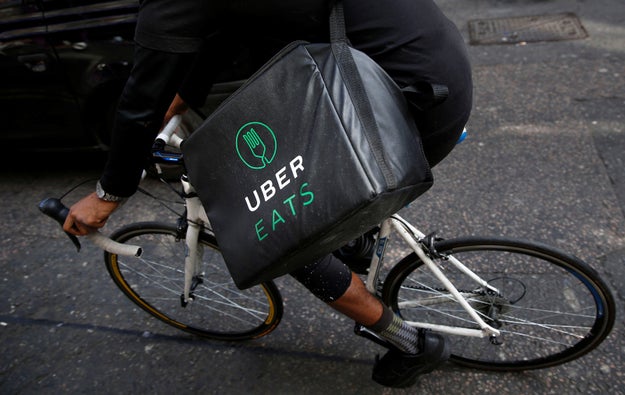
Neil Hall / Reuters
On the steps of New York's City Hall tomorrow morning, a group bike messengers will launch the New York Messengers Alliance, a first-of-its-kind organization for couriers who work for on-demand apps like Instacart, Postmates and Uber.
While not a formal union, the alliance aims to build power and solidarity among the labor force that supports the delivery-app economy, its organizers say. They want to use this power to negotiate for better working conditions, and their first priority is worker safety — specifically a demand for company-provided safety gear like helmets, and workers&039; compensation when they&039;re injured on the job.
Of the half dozen workers who attended an organizing meeting for the alliance earlier this month, two wore casts, and a third rolled up his sleeves to show grisly scabs from a recent crash. Sadio Bello, an Uber Rush courier who has worked as a bike messenger for 17 years, rode and made deliveries with a fractured ankle this past summer, he told BuzzFeed News, because he didn&039;t want to lose money.
Bike messengers working for the on-demand apps are classified as independent contractors, rather than employees, just like Uber drivers. They don&039;t receive any paid leave or medical cover.
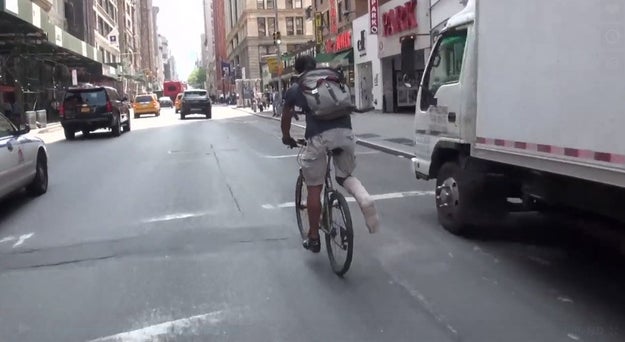
Uber Rush courier Sadio Bello making a delivery while injured in New York.
Zishun Ning / Via vimeo.com
“Never in 20 years have I had a paid vacation,” courier Kurt Boone told BuzzFeed News. After two decades in the field “with nothing to show for it — no pension, no 401(k),” Boone said he sees an opportunity for the next generation of messengers in the alliance.
“Generally most messengers don’t work together. They’re individuals,” he said. “Collectively, I think we can go further.”
While little formal data exists on injury rates for bike messengers, a 2002 Harvard study of the profession in Boston found a rate comparable to that of professional football or the meatpacking industry, noting that “most injuries go unreported and that most couriers do not carry health insurance.”
Messengers say their experiences support those findings, and the danger comes with the territory. But they also insist companies could do more to protect and support them, and take issue with the apps&039; unpredictable pay and all-hours work-schedules. It combines, they say, to pressure couriers to do dangerous amounts of work just to earn as much as they used to with more regular schedules and rates.
“Initially, it was a fantastic deal,” said Harrington Día, who delivers for Uber&039;s Rush service, as well as for other companies. Día said he was initially drawn to the work by the $25 an hour wage Uber advertised. “I saw it as a way where I could live out this utopian fantasy of biking for a living,” he said. “That shattered when they began cutting wages.”
Día and others watched guaranteed pay steadily drop over the past two years for Uber Rush jobs, from $25 an hour to $20 to $15 and lower. When the company changed the delivery rate from $4 for a hand-off and $5 per mile to $3 for a hand-off and $4 a mile this past November (which meant workers could make as little as $7 per delivery), some couriers began showing up to protests by Uber drivers, who had also been dealing with pay cuts.
“The truth is they’ve been taking too much of the pie and we baked that pie and now we’re getting crumbs of it,” said Día.
Uber says couriers sign up for its service because of its flexibility. “Since couriers can and do use many other apps, we have to work every day to make Uber more rewarding for couriers, and we’re focused on just that, including by listening to feedback and making improvements,” the company told BuzzFeed News.
Instacart declined to comment on the new worker alliance, and Postmates did not respond to a request for comment.
Elsewhere, organizing efforts by workers for these same on-demand companies are already racking up results. Even without the support of the new alliance, independent contractors for Instacart successfully won concessions from the company with the threat of a strike last week. After the contractors planned to “boycott” working for the platform for two days, the company agreed not to change its base pay and tip structure.
And independent contractors for Postmates received a boost from a complaint filed by the National Labor Relations Board against the company in Chicago, in which the board&039;s lawyers found Postmates couriers are employees, according to The New York Times, which received a copy of the complaint via a Freedom of Information Act request.
The protests also have an international element. In August, London-based couriers on the platform Deliveroo, an Uber Eats competitor, went on strike for seven days over a proposed new working contract. Deliveroo “subsequently backed down and said the new contract was an optional trial, although anyone who stayed on the old contract had to change to a zone where the new contract has not yet been implemented,” BuzzFeed News reported.
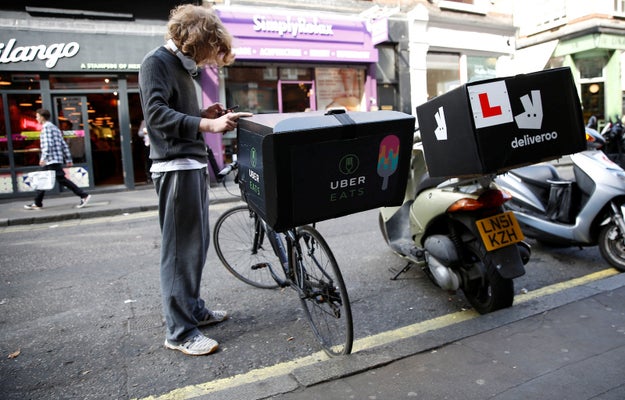
An UberEATS food delivery courier waits for an order in London, Britain September 7, 2016.
Neil Hall / Reuters
Last week also saw a new ruling related to the employee status of Uber drivers in New York (which the company is appealing), which found the workers qualify for unemployment benefits. And a bill being considered by the New York City Council would mandate on-demand companies like Uber provide safety equipment and training to couriers, despite their status as independent contractors.
The delivery workers in the messengers alliance, most of whom accept jobs from more than one app to make a living, are affiliating with the National Taxi Workers Alliance, an AFL-CIO-member union of taxi drivers that prides itself on its militancy. (In a flyer publicizing the launch event, the NYTWA calls itself “the only union to take Uber to court on behalf of workers.”) Founded in 1998, the NYTWA represents 19,000 yellow cab, green car, and black car drivers, including Uber and Lyft drivers.
“There are unions out there that don’t want to fight for employee status,” said Bhairavi Desai, executive director with the NYTWA. “They have articulated that position for themselves. To us, it&039;s clear that the role of the union is not to tactically make concessions to protect the business model, but to uncompromisingly elevate the power of the workers.”
Quelle: <a href="Delivery Workers For Instacart, Postmates And Uber Are Teaming Up For A Better Deal“>BuzzFeed
Compared to Silicon Valley giants like Facebook and Google, Apple's AI research projects have been largely inscrutable. But now, that looks like it&039;s about to change.
Apple has hired esteemed Carnegie Mellon computer science professor Russ Salakhutdinov as its director of artificial intelligence research, with plans to build a team of researchers for the company in the coming months. Salakhutdinov will remain in his post as an associate professor at CMU, Apple confirmed to BuzzFeed News.
And in a move uncharacteristic of Apple&039;s historically secretive approach to its AI efforts, Salakhutdinov tweeted news of his hiring along with a link to his new team&039;s job listings.
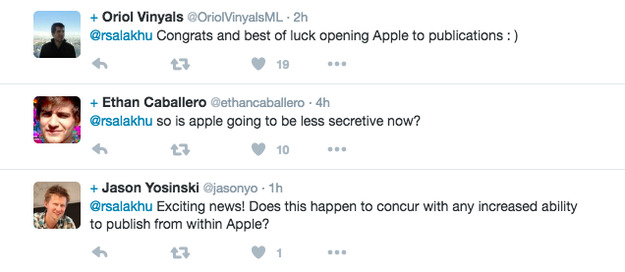
Researchers replied to Salakhutdinov expressing skepticism about whether or not Apple, which is typically quiet about its artificial intelligence and machine learning efforts, would open itself up to the larger, more collaborative AI research community. The unexpected tweet seems to be part of Apple&039;s plan for recruiting for AI researchers — who are so hot right now in Silicon Valley.
All three of these men are artificial intelligence researchers. Vinyals works at Google, Caballero at Talla, and Yosinski at Geometric Intelligence.
Siri, Apple&039;s big public-facing AI technology, has faced widespread criticism for not being smart enough, especially compared to rival AI assistants. Just last week, Walt Mossberg, executive editor of the Verge and editor at large of Recode, asked, “Why does Siri seem so dumb?” in a recent column.
And Apple&039;s competitors have made very public strides into artificial intelligence, including being aggressive about hiring AI experts to take their research further. Google has been publishing hundreds of papers on machine learning. It&039;s also created a suite of products for varying levels of engagement: the Go champion DeepMind, the Siri-esque Google Now, the open source TensorFlow for developers, and the new texting bot Allo, to name a few. Amazon&039;s Echo speaker, whose key features rely the voice-controlled AI assistant Alexa, is rapidly reaching customer demographics outside of traditional smartphone markets. Facebook introduced its own personal assistant, M, in late 2015, just a year after Microsoft debuted Cortana.
Meanwhile, Apple has kept a low profile at the annual Neural Information Processing Systems Conference, which is the event of the season for researchers and companies developing and studying artificial intelligence. Google, Microsoft, Facebook, and IBM have all been active participants.
But Apple is racing to catch up. Before hiring Salakhutdinov, the company acquired three machine learning companies in the past year: Perceptio, Turi, and Tuplejump. And just this week, CEO Tim Cook told Nikkei Asian Review that Apple plans to open an AI research center in Yokohama, Japan later this year. “There is an incredible future ahead for AI and the iPhone,” Cook said.
Quelle: <a href="Apple Hires Director Of Artificial Intelligence To Ramp Up AI Recruitment“>BuzzFeed

Nimret Sandhu has shown himself to be a key player in the success of the #Docker Seattle Meetup group; and now with almost 2000 eager members, organizing engaging events has become quite the responsibility! On top of his busy work schedule at Dev9, his extracurricular activities and a family life, Nimret took the time to tell us his Docker story, his favorite thing about the Docker Community and also departed with some words of wisdom for anyone just starting a meetup group.
Tell us about your first experience with Docker. What drew you to joining as an organizer for the Docker Seattle Meetup group?
My first experience with Docker was when our company, Dev9, looked into partnering with this up-and-coming startup named Docker a couple of years ago. Since I’m a long time *nix user who’s been exposed to solaris zones, bsd jails, etc. in the past, I looked into it, and immediately realized the potential. Once I downloaded and played around with it, I was so blown away by the technology that I started evangelizing it to our clients. I gave a talk on it and volunteered to help out with the Docker Seattle Meetup. I had already been running the Seattle Java User’s Group for a few years, and it was quite natural for me to volunteer to join the Docker Seattle Meetup group since I am quite passionate about technology.
Now that you use Docker, how do you use it and what do you use it for?
In my role as Director of Technology for Dev9, I am expected to delve into technical nuances when necessary while also managing multiple teams for clients in the Seattle area. Accelerated, rapid development is critical. Docker allows me to experiment with various enterprise-related technologies, primarily in the Java and JavaScript space. Projects are typically software development and/or Continuous Delivery leveraging tools such as the JVM, Jenkins, Spring Boot etc.
Docker is extremely easy to work with and provides a convenient way to package a solution together. I’ve found it to be incredibly helpful in accelerating my speed of development.
What are some aspects you love about organizing Docker Meetup events?
I love the energy and diversity within the Docker community. People really have an interest in this tech and the domain. When people take the time to show up, it makes a big difference. We always have a great turnout and people are very engaged.
What I love about organizing the events is that we have such a wide variety of presentations. A mix from vendors, companies who use the technology, or people who are playing around with it for their own needs. It’s a great forum to exchange ideas, network and even find the next opportunity.
What advice would you give to a new organizer that just started their Docker Meetup group?
Start small, but start. The journey of a thousand miles begins with a single step.
Get the word out. Put info on community calendars (i.e. WTIA, Geekwire) and applicable places that people read. You can even mention this event at another meet-up. Look into mailing lists for start-ups or small organizations.
Coordinate with people who run other meetups to leverage synergies.
Ask for volunteers and companies to help.
Seek sponsorships – many local businesses and companies are interested in hosting, providing food or being involved in other ways.
Attend other meetups to gain tips and thoughts from the organizers. Network with them on-going.
What do you do when you are not organizing meetup events?
As the Director of Technology for Dev9, I lead teams of software developers and am responsible for the projects we have in the Seattle area. Most of the projects are server-side, client-side and mobile. I help assemble teams, assist business development efforts, conduct up-front assessments for clients, hire and retain staff, and manage projects to ensure customer satisfaction and best practices in modern software development techniques. I am also the chair of the Seattle Java Users Group (SeaJUG), and have been for the last decade. I am on multiple Advisory Boards with the University of Washington Professional and Continuous Education program and help set direction and content in technology, ensuring that the programs stay up-to-date. Most importantly, I’m a father to my two lovely daughters and enjoy family time in general.
Take look at my Geek of the Week feature for more info!
Motto or personal mantra?
Work hard, play hard.
Huge shout out to Nirmet Sandhu and all docker meetup organizers for their contributions! Click To Tweet
The post Docker Community Spotlight: Nimret Sandhu appeared first on Docker Blog.
Quelle: https://blog.docker.com/feed/
AWS is excited to announce immediate availability of the new US East (Ohio) Region. Ohio joins Northern Virginia, Oregon, Northern California, and AWS GovCloud as the fifth AWS Region in North America and as the fourteenth worldwide, bringing the total number of AWS Availability Zones to 38 globally.
Quelle: aws.amazon.com

Netflix kann wieder einen hohen Zuwachs bei den Abonnenten melden. Zuvor war der Streaminganbieter eingebrochen, und es gab Übernahmegerüchte über Disney. (Netflix, Disney)
Quelle: Golem






