Snapchat's Parent Company Could Go Public As Early As March

John Paczkowski

Snap Inc, maker of Snapchat, is preparing paperwork for an IPO that could value the firm at $25 billion, the Wall Street Journal reports; the paperwork indicates that the IPO could happen in March of 2017.

The possible valuation is a marked jump from Snap&;s previous market cap, $17.8 billion, first reported in May.

Thought it is not clear whether Snap Inc is a profitable business, it generated $60 million in revenue in 2015 and is on track to earn $250 and $350 million in 2016, according to the Journal. Snapchat has projected it could earn $1 billion in revenue in 2017.

The news comes on the heels of Snap Inc&039;s first hardware product, Spectacles.

Snapchat declined BuzzFeed News&039; request for comment.

Quelle: <a href="Snapchat&039;s Parent Company Could Go Public As Early As March“>BuzzFeed

New resource blade for Azure SQL Data Warehouse

We’re happy to introduce a new top level resource blade for Azure SQL Data Warehouse that allows you to quickly manage all of your databases. You can use the SQL Data Warehouse resource blade to quickly scan through your data warehouse for details like the name, status, server, pricing tier, location, and subscription. You can find the new SQL Data Warehouse resource blade on the left navigation. Simply click the SQL data warehouses link to get started. Customization If you can’t see the new left navigation or would like to move it the top of your Azure portal, you can use the customization features of the Azure portal to place the link we’re you would like. Enable the SQL Data Warehouse Link If the link is not enabled in your portal, you will have to manual enable it. To enable the link, you can click on the Show Menu link in the left navigation. Once expanded, click on the More Services link at the bottom of the list of items. Then scroll to find the SQL data warehouses link. Simply click the star on the right, turning it to yellow, and the link will appear. Moving the Link You can move the link anywhere on the left navigation exposing the grab handle. You can simply drag the link to anywhere on the left navigation. Learn more Check out the many resources for learning more about SQL Data Warehouse, including: What is Azure SQL Data Warehouse? SQL Data Warehouse best practices Video library MSDN forum Stack Overflow forum
Quelle: Azure

Introducing a Node.js Library for Porting Express Applications to Amazon API Gateway and AWS Lambda

You can now use aws-serverless-express, an open source Node.js library, to simplify the migration of your Express web applications and REST APIs to a serverless architecture. The library is built using features from Amazon API Gateway that allow you to preserve your API routes in your existing web application frameworks without having to redefine API methods or their integration behavior on API Gateway.
Quelle: aws.amazon.com

AWS CloudFormation Adds Improved Permissions Controls, Cross-Stack Reference Enhancements, and Resource Coverage Updates

You can now allow AWS CloudFormation to assume service roles which determine what CloudFormation is allowed to do with your stack. A service role is an AWS Identity and Access Management (IAM) role which can be assigned permissions that determine which AWS resources CloudFormation can create, update, or delete. For example, you could create a service role that only allows CloudFormation to perform actions with Amazon EC2. Previously, CloudFormation would use the default permissions from the user credentials you used to access CloudFormation. Using service roles with CloudFormation, you can now more easily set granular permissions to CloudFormation for different AWS accounts or IAM users. To get started, you can set a service role when creating, updating, or deleting a stack. You will also need permission to pass the role to CloudFormation. Learn more about this feature in the documentation.
Quelle: aws.amazon.com

Spotify Ads May Have Served Malware To Your PC

Spotify users are complaining that Spotify Free is infecting their browsers with malware via ads on the music streaming site. The virus opened “questionable website pop-ups” on browsers, as Spotify called them in a reply to a request for help.

The issue has affected Mac, Linux, and Windows users, the BBC reports. Spotify Premium subscribers, who pay for the service, do not see any ads and were therefore not vulnerable to the attack.
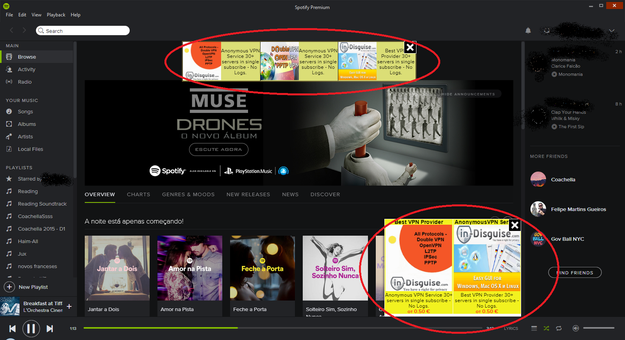
Spotify user Titaviana’s Spotify application. Other Spotify users responded to her complaint by saying she should reinstall the application to get rid of the unsightly banner ads. She made her complaint in June 2015.

Spotify user Titaviana / Via community.spotify.com

Spotify user “tonyonly” posted on the Spotify Community page, “There&;s something pretty alarming going on right now with Spotify Free. If you have Spotify Free open, it will launch – and keep on launching – the default internet browser on the computer to different kinds of malware / virus sites. Some of them do not even require user action to be able to cause harm.” According to tonyonly, the ads do not require clicks to infect users’ computers.

Spotify responded to the tonyonly saying that it had shut down the issue and that only a small number of users had experienced difficulties. The company called the incidents “isolated.”

Other users voiced their concerns on Twitter:

The BBC reported that maladvertising appeared on Spotify in 2011, the year the streaming service launched in the US, and hit users with the Blackhole Exploit Kit, a type of Trojan Horse virus. Users saw malware-infected advertising banners within their Spotify applications that then ran malicious code within their browsers. Spotify later apologized for the problem.

Maladvertising isn&039;t the only gripe people have with Spotify&039;s advertising. Users have complained on Spotify&039;s community page of too many ads, repeating ads, and seeing ads even after paying for Spotify Premium.

This isn&039;t the only gripe people have with Spotify&039;s advertising. Users have complained on Spotify&039;s community page of too many ads, repeating ads, and even seeing unsightly banner ads.

Austin Kramer, global head of dance and electronic music at Spotify, said at a recent conference, “Our ad team is building ways for the free product to be profitable,” suggesting that Spotify is searching for new ways to serve users advertisements. Spotify, which claims 40 million paying subscribers and 100 million active users, is not yet a profitable business.

Spotify has not yet replied to a request for comment.

Quelle: <a href="Spotify Ads May Have Served Malware To Your PC“>BuzzFeed

Popular Photo Altering App Prisma Will Now Transform Your Videos Into Wild, Otherworldly Scenes

Popular Photo Altering App Prisma Will Now Transform Your Videos Into Wild, Otherworldly Scenes

Prisma, a popular photo altering app that transforms photos into artistic-looking images, is today introducing video effects that transform everyday life into fantasy worlds.

Prisma, a popular photo altering app that transforms photos into artistic-looking images, is today introducing video effects that transform everyday life into fantasy worlds.

Prisma uses AI to “repaint” still images in the styles of famous painters. It debuted in June and already has 70 million users, according to co-founder Aram Airapetyan.

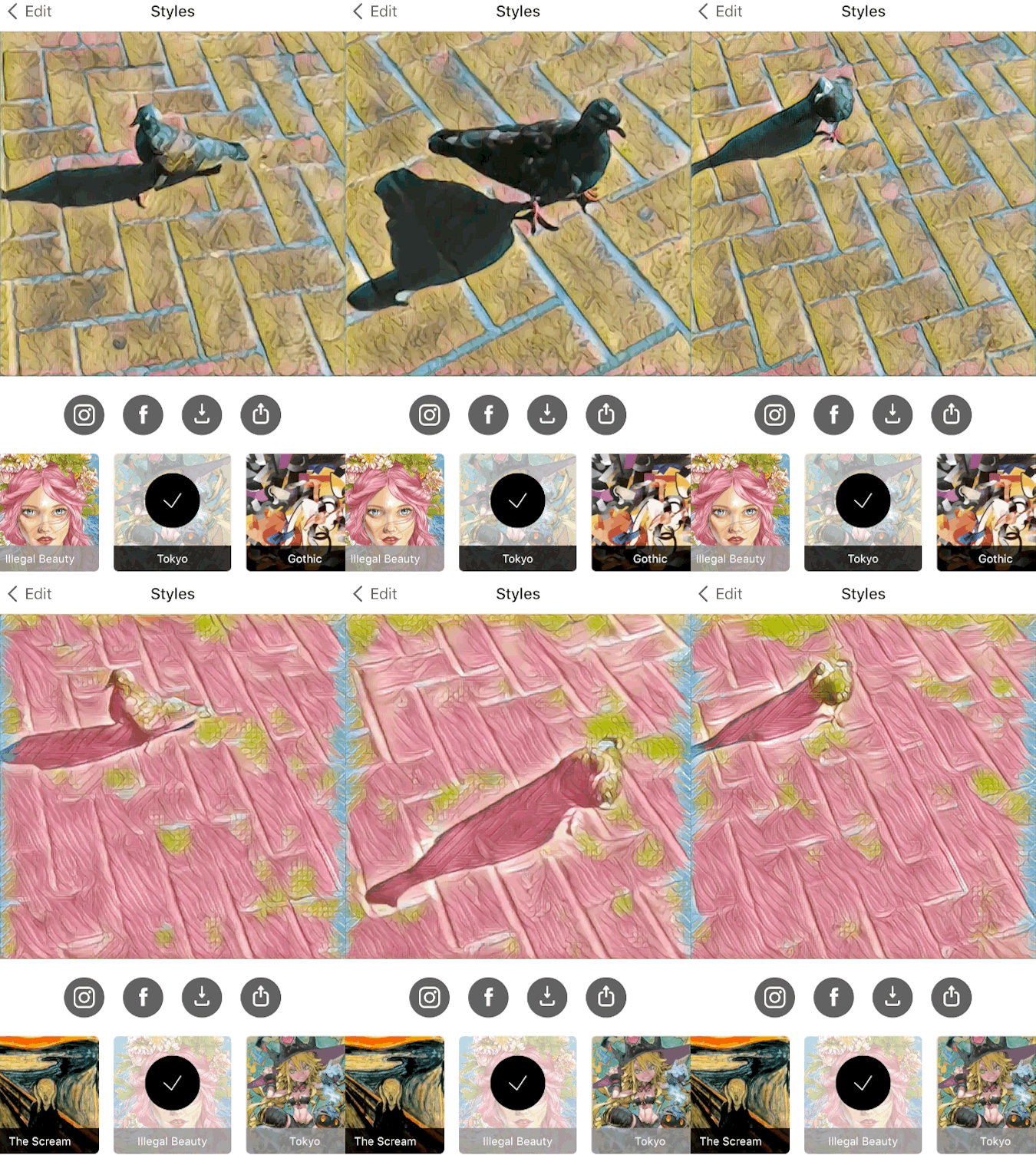
Okay, on to Prisma&;s effects. Take a look at this video of Ocean Beach in San Francisco (turned into a GIF):

Now check it out with Prisma&039;s effects applied:

Here&039;s a GIF of the first debate between Hillary Clinton and Donald Trump:

giphy.com

And here it is in Prisma&039;s appropriately titled effect: “The Scream,” a tribute to Edvard Munch&039;s 1893 painting of the same name.

Here&039;s a boring video of me on Market Street in San Francisco:

And here it is with Prisma:

Now take a look at this Pigeon:

See how much better it looks like inside Prisma?

Prisma takes a moment or two to convert the videos, so be prepared for wait for a bit.

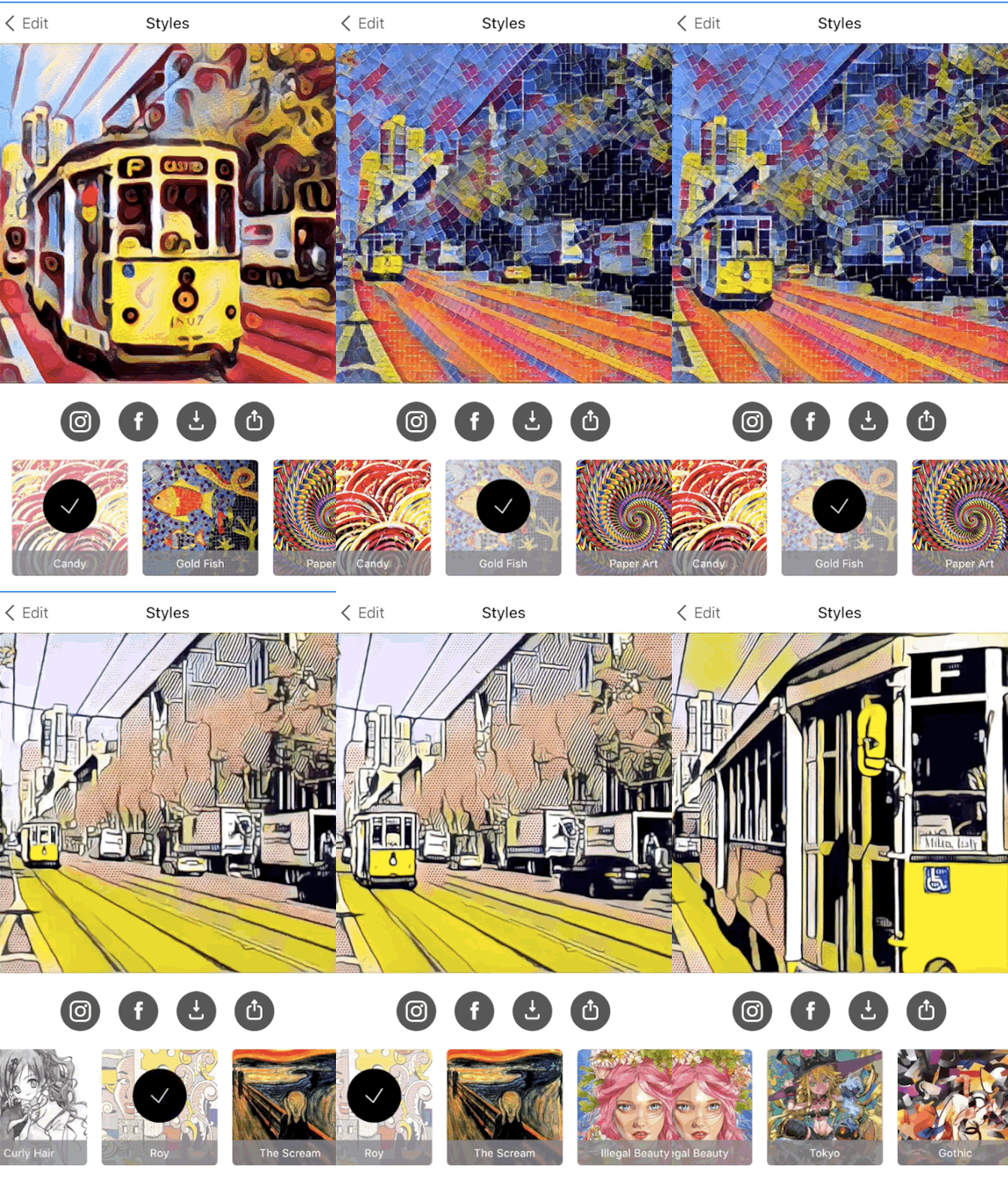
Here&039;s a look at a few more Prisma effects doing work on the San Francisco Muni:

Prisma has already processed 3 billion pictures. Some users have even made their own makeshift Prisma videos by stitching together hundreds of Prisma processed photos. Such as this rock video:

youtube.com

The video feature will be available globally on iOS starting today.

Quelle: <a href="Popular Photo Altering App Prisma Will Now Transform Your Videos Into Wild, Otherworldly Scenes“>BuzzFeed

How to authenticate users on Google App Engine using Firebase

Posted by Tristan Vanech, Technical Writer Intern

Google App Engine offers a variety of user sign-in options, but what if you need a full stack solution for authentication, including verifying access tokens on the server? Meet Firebase Authentication, a complete sign-in experience that provides a drop-in UI, powerful SDKs, and, yes, backend services for token verification.

Firebase, Google’s backend as a service offering for creating mobile and web applications, has Node.js and Java server SDKs for integrating your own servers with Firebase Authentication. The Firebase Java server SDK offers a built-in method for verifying and decrypting tokens that you can use for authentication in Java App Engine apps, but no such SDK currently exists for the rest of the backend languages in App Engine.

Because using third-party JSON Web Token (JWT) libraries to manage authentication for other languages can be difficult, we just published a solution for Firebase Authentication on App Engine with Python, the first in a series for App Engine languages.

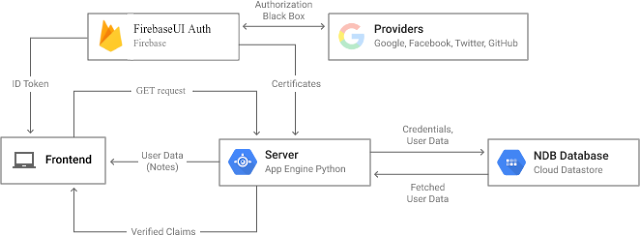
The tutorial walks you through a simple note-taking application called Firenotes that stores users’ notes in their own personal notebooks, which are identified by a unique user ID generated by Firebase. The application stores credentials in Google Cloud Datastore, but you can store them in any database, and even integrate your existing credentialing system with the user-ID-based method that Firebase uses.

(click to enlarge)

As the diagram above demonstrates, Firebase both mints the access tokens and provides public key certificates to verify them, so you need only to implement the verification code, which we have written for you.

We hope this solution helps you handle authentication quickly, so you can get back to writing the meat of the next great app!

Quelle: Google Cloud Platform

Microsoft Cloud in India

As we celebrate the one-year anniversary of the Microsoft Cloud in India, I wanted to share some examples of the great outcomes our customers have been able to achieve since moving to the cloud, as well as some of our continued efforts to make Microsoft Azure the platform of choice for customers in India. 

In September 2015, Microsoft was the first global cloud provider to offer services from local datacenters in three regions in India (Central, South and West). These regions provide our customers with trusted cloud services that help them meet local compliance and policy requirements. In addition, replication of data in multiple datacenters across India gives customers reliable, geo-redundant data protection for business continuity, for both pure cloud and hybrid scenarios.

With India’s rapidly expanding economy, we see an incredible opportunity to help customers of all sizes and industries take advantage of the cloud. Today, customers across the public sector, financial services, healthcare, and rapidly growing startups, are all choosing Azure to help go faster, achieve more, and grow their businesses. As we look back on the past year, we are proud to see our customers’ achievements, for example: 

Reliance General Insurance bringing health benefits to millions of under-privileged people across the country
Sri Chaitanya Schools delivering superior quality personalized education
Fortis Healthcare creating value for healthcare organizations and patients

Since launch, we have continued expanding our service offerings and provided over 50 Azure services locally, combined with compliance certifications such as ISO 27001, ISO 27018, SOC 1, SOC 2, and PCI.

Today, I’m pleased to share that we are continuing our investment in India by opening additional subscription options. We have enabled Indian customers to access Azure’s India regions via credit card (direct online subscriptions). This allows customers to leverage the full power of our hyperscale offering on demand. Additionally, we have enabled Cloud Solution Provider (CSP) subscriptions to access India regions. Our CSP partners around the world deliver high value services on top of Azure, with fully integrated customer support and billing. We are very excited to expand these programs to India, and expect them to continue to fuel innovation in the market.
Quelle: Azure