GUEST BLOG: Forrester’s Total Economic Impact Study of Red Hat CloudForms

The Red Hat Management portfolio has seen significant upgrades, including the latest release of Red Hat CloudForms 4.1, and has delivered efficiency and costs savings to worldwide customers. This is confirmed by analysts research and testimonials from customers like Cox Automotive, who saved almost 10 years of time and almost $5 million in soft savings. Moreover, because CloudForms supports a wide variety of platforms, including three of the largest public clouds – Amazon Web Service, Microsoft Azure and Google Cloud Platform, CloudForms is well-suited for enterprises seeking to manage various stages of virtualization and cloud deployments, as well as containers. The following blog, written by Forrester Consulting, provides an example of the economic impact CloudForms could have on your business.
Author’s note: The following blog details a recent Total Economic Impact (TEI) study conducted by Forrester Consulting centered around Red Hat CloudForms. The results of that study can be viewed here.

GUEST BLOG: Forrester’s Total Economic Impact Study of Red Hat CloudForms
By: Forrester Consulting
Red Hat commissioned Forrester Consulting to conduct a Total Economic Impact (TEI) study to examine the value that Red Hat CloudForms customers could achieve by deploying Red Hat CloudForms. We spoke with a large US software company about the benefits, costs, risks, and flexibility of Red Hat CloudForms and cloud management platforms. This company has roughly $4B in annual revenue, 7,500 staff, and sells its software to both businesses and consumers.
Prior to Red Hat CloudForms, this customer had developed and maintained an internal, “homegrown” solution. 45 people from different teams regularly worked on this solution to both “keep the lights on” and make incremental improvements. However, with growing and more frequent requests from the business and staff turnover challenges, the company found it difficult to continue using its homegrown solution.
The company then embarked on a selection process to evaluate different vendor technologies that could replace the internal solution. After researching 10 vendors and narrowing down to 6 for technical assessments and conceptual discussions, the customer offered a 2-week POC opportunity to 2 vendors. The POC would consist of proving out the vendor’s performance and capability in completing the company’s 140 use-case test. While the alternative vendor was unable to complete all the use cases given an extended 6 week timeline, Red Hat was able to complete more than 140 use cases in 1.5 weeks.
Readers should also consider running similar tests that relate a conceptual POC to scenarios that are more realistic and frequent to your environments. Some example use cases that the company mentioned were:

Due to the company’s heavy security constraints, apply different provisioning restrictions to different groups and adjust them uniquely and under a single tenant.
Integrate with Active Directory (AD) to have the same message groups.
Apply single sign-on (SSO).

After setting deployment goals, the company began to introduce Red Hat CloudForms into its environment. The two main benefits that the company experienced were unified service management efficiency and unified service delivery efficiency.
Unified service management efficiency focuses on the reduction in labor and effort to develop, maintain, and upgrade the internally built solution. The company was able to reduce 45 allocated resources to 10 resources in the first year of deploying Red Hat CloudForms. This 10-person team was reduced to 8 in Year 2 and 7 by Year 3. This allowed the customer to reallocate resources to other business enabling and future-thinking custom projects. This can be interpreted as either an approximately 80% efficiency improvement or that the previous state was 4.5x less efficient.
Unified service delivery efficiency centers on the reduction in labor and effort to provision and answer business user requests during the organization’s three-month peak season. In past peak seasons, a group of 100 internal resources from different departments and 30 contractors would be co-located for three months to answer all business unit requests. After the first year of deploying Red Hat CloudForms, the customer was able to provision 50% quicker with the same volume of staff.
By the second year, the customer was able to provision 91.7% quicker and did not need any of the 30 contractors anymore. After accounting for initial and recurring costs, risk-adjusting for realistic and conservative estimates, and the future value and scalability of Red Hat CloudForms, we found that the interviewed company experienced a 97% ROI, $ 5.95M net present value, and 6.8 month payback period over a three-year model. In addition to reallocating 35-38 resources to more value-add activities, the company avoided $900K-$1.8M in peak-season contractor costs by engaging a more efficient platform.
For more information on the full June 2016 case study, The Forrester Total Economic Impact of Red Hat CloudForms, please reach out to your Red Hat representative.
Quelle: CloudForms

Here’s How To Make Sure Facebook Doesn’t Have Your Phone Contacts

There may be some privacy settings and policy changes you may have missed.

Take a look at contacts you may be uploading to Facebook without realizing it.

Take a look at contacts you may be uploading to Facebook without realizing it.

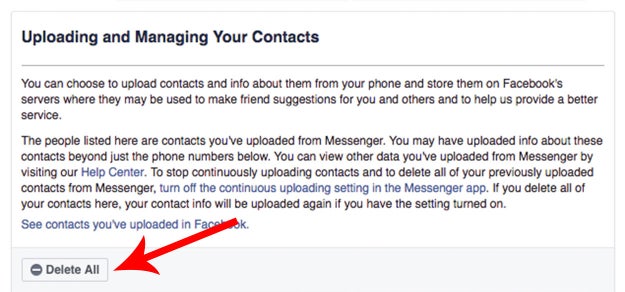
Facebook could be using contact information, including names, phone numbers, and email addresses, that&;s stored in your phone to make friend recommendations to others. This can be problematic when your contacts are confidential sources or patients.

You can view these imported contacts here. There should be a Delete All button at the top of the list that will clear all contacts at once. I had apparently uploaded over a hundred of my high school friends&039; contact information in Facebook, when I first joined the service.

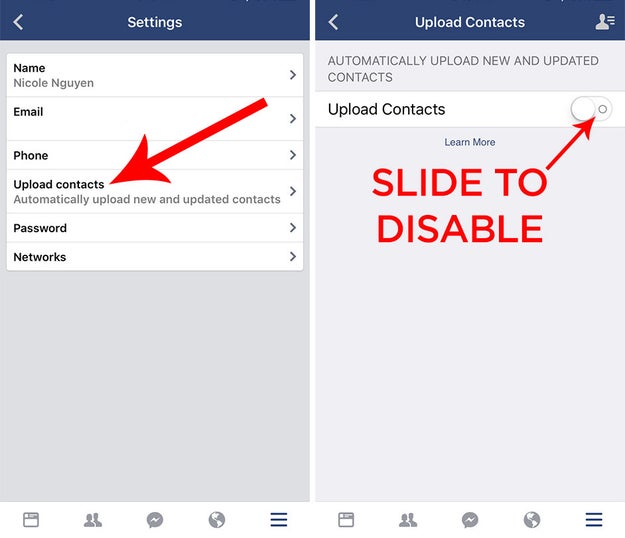
You can prevent Facebook from uploading contacts in the future by tapping on the menu button on the bottom right, scrolling to the bottom of that page and tapping Privacy Shortcuts > More Settings > General > Upload Contacts > and then disable Upload Contacts. Manage the contacts you may have uploaded to Facebook Messenger here.

Nicole N / BuzzFeed

Nicole N / BuzzFeed

Prevent WhatsApp from sharing your data with Facebook.

Prevent WhatsApp from sharing your data with Facebook.

On Aug. 26, the messaging service WhatsApp, which was acquired by Facebook in 2014, announced that it was going to start sharing user information, like what device you&039;re using, your mobile carrier, and how often you open the app, with Facebook. Facebook would use this data to inform what types of ads it serves you. The app is giving users 30 days after agreeing to WhatsApp&039;s new terms of service to opt out.

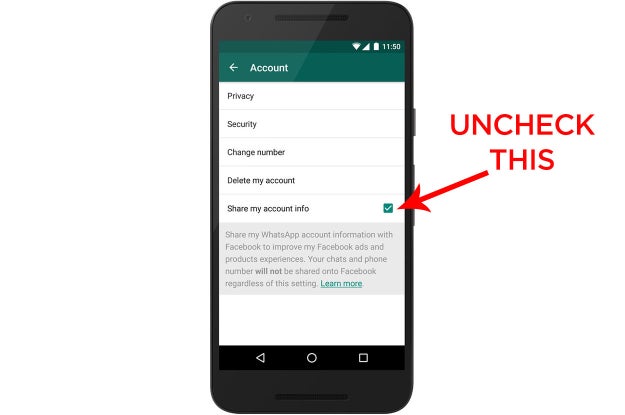
In the WhatsApp app, go to Settings > Account and uncheck Share my account info. If you have not accepted the new privacy policy yet, another method of opting out is to tap Read more about the key updates to our Terms and Privacy Policy when prompted and slide the green toggle to the off position at the bottom of your screen.

If you&039;ve already opted out, you may no longer see the option to opt back in.

WhatsApp / Nicole N / BuzzFeed


View Entire List ›

Quelle: <a href="Here’s How To Make Sure Facebook Doesn’t Have Your Phone Contacts“>BuzzFeed

Infrastructure software is dead. Long live infrastructure software.

The post Infrastructure software is dead. Long live infrastructure software. appeared first on Mirantis | The Pure Play OpenStack Company.
Mirantis Co-Founder and CMO Boris Renski recently stirred discussion with his blog post that infrastructure software is dead. At this year&;s OpenStack Days Silicon Valley, he sat down with Battery Ventures Technology Fellow Adrian Cockcroft to talk about the changing paradigms in software and in delivery models, and the results were not what you might think.
In general, there are two different methods for deploying software.  Traditionally, in the pre-cloud paradigm, software is deployed as a monolithic package.  You deploy it, and 6 months, or 12 months, or 7 years later, when a new version comes out, you basically throw it out and start again, hoping your data and processes will still be compatible with the new version.
But those days are over, Boris argued in his blog post.  They simply aren&8217;t sustainable. Things move too fast; improvements are available for months or years before you can take advantage of them under this model.  So what do you do instead?
That question was on the mind of most of the audience for Boris and Adrian&8217;s discussion.
OpenStack and the old way
In the early days of Mirantis, Boris explained, the company used the pre-cloud paradigm, where the product is packaged as a whole, delivered, and then periodically updated. They quickly learned — and as anyone who has attempted to upgrade OpenStack knows — this isn’t feasible for OpenStack, which itself uses the Infrastructure as Code (IaC) model.
What&8217;s more, as cloud technology proliferates, the shift in paradigm away from traditional, pre-cloud views has become less about software and more about the delivery model.
So what do you do?
You abstract. Boris clarified this shift in paradigm with AWS as an example. AWS users aren’t provided the infrastructure software but rather an API to the interface. That way, AWS can change whatever it needs to in the infrastructure software without disrupting clients and users.
But it&8217;s more than that, Adrian explains. People initially want something that works without change — until they need a new feature. Such project-based thought was built on the fact that coding is expensive and slow, which is why bundling a package periodically was the norm. Now, with procuring hardware and downloading software from places like Github taking minutes, the purchasing and deployment cycle has collapsed. A deployment can take seconds simply by firing up a Docker container.
Basically, the entire reason for bundling has gone away.
Taking advantage of the new software paradigm
To adapt, the software community has learned to break everything into microservices that can deploy independently, resulting in lots of versions of things constantly changing.
But &; doesn’t that break a lot then? Of course, Boris explained, but because you end up with a series of very small steps, it’s actually easier to detect problems and roll back to the previous version. As programmers will recognize, this is the same process used to debug, one step at a time, and it allows continuous change.
This process also solves the issues that arise regarding operations when updates need to be made. Previously, you’d have to wonder if you needed to bring all or part of your system down to make the updates. With containerized OpenStack services, you could upgrade each one independently.
And don’t forget the security benefits of updating in place.
Exploits of exposed software are proliferating, and as Adrian says, people are still downloading the same old vulnerable applications. He advised building around good source components that you can verify with services like JFrog Xray and use security scanners (Docker has one) to check your products.
Looking at the future
There are still a lot of issues that need solutions, of course.
Adrian pointed out that managing a multi-vendor dependency tree is a complex problem with no good fix. “You have to figure out how to keep everything going while trying to change everything,” he explained.
The goal is to keep the “northbound” components, that is, the APIs and so on, that developers want to use, evolving, but remember that the “southbound,” or hardware-facing components, act as constraints. This problem requires collaboration and partnerships to support these devices and to work out ways to get all the versions of hardware and software to work together.
Missed this year&8217;s OpenStack Days Silicon Valley? You can see the whole panel. Just head on over to the OpenStack Days Silicon Valley 2016 videos page and scroll down to &;Infrastructure Software Is Dead…Or Is It?&;
The post Infrastructure software is dead. Long live infrastructure software. appeared first on Mirantis | The Pure Play OpenStack Company.
Quelle: Mirantis