People Are Freaking Out Because Read Receipts Have Come To Twitter

Twitter announced a bunch of new features overnight, including typing indicators (“…”), web link previews and, most controversially, read receipts.

Read receipts have been unpopular since they were first introduced on Blackberry Messenger, then the iPhone and early Facebook Messenger, where they are turned on by default. When the news spread that Twitter had finally joined the read receipts bandwagon, people were a little bit tense.

Those who don&;t want read receipts all over their DMs needn&039;t worry. You can disable them pretty easily in the settings:

Quelle: <a href="People Are Freaking Out Because Read Receipts Have Come To Twitter“>BuzzFeed

Facebook Co-Founder Commits $20 Million To Help Democrats Win In 2016

Dustin Moskovitz, the billionaire co-founder of Facebook and Asana, announced on Thursday that he intends to give $20 million to a “number of organizations” to help Democrats, and Hillary Clinton, win in 2016.

Moskovitz published a fiercely-worded Medium post arguing that Republican nominee Donald Trump is “running on a zero-sum vision” and that his attempts to woo economically disenfranchised voters “are quite possibly a deliberate con, an attempt to rally energy and support without the ability or intention to deliver.”

He also wrote that while he and his wife, Cari Tuna, have previously voted for Democrats in presidential elections, this is the first time they endorsed a candidate and donated.

The move represents a sharp break with Asana and Facebook board member, Peter Thiel, a Trump delegate who spoke at the Republican National Convention and earlier this week published an op-ed in the Washington Post in support of the Republican nominee.

It&;s not the first time he&039;s broken with his board member, or distanced himself from Trump. In June, in response to a BuzzFeed News inquiry, Moskovitz seemed to distance himself from Thiel, and disavowed Trump&039;s comments on Muslims.

It&039;s also the latest example of Silicon Valley coming out swinging against Trump. In July, a group of 150 Silicon Valley heavyweights published an open letter condemning the candidate.

BuzzFeed News has reached out to a Moskovitz representative for comment.

Quelle: <a href="Facebook Co-Founder Commits Million To Help Democrats Win In 2016“>BuzzFeed

Gaming is serious business

The post Gaming is serious business appeared first on Mirantis | The Pure Play OpenStack Company.

G-Core Labs had a problem.

The Luxembourg-based global IT solutions provider, which offers a wide range of services, including hosting, CDN, peering network and different levels of support, focuses on creating custom solutions designed to address specific needs of their clients. This meant that securing the online gaming company Wargaming (the makers of World of Tanks, World of Warships and World of Warplanes) as one of its first customers led to G-Core building an unprecedented network infrastructure to support the explosive growth of Wargaming’s World of Tanks audience.

This expertise led G-Core to become the hosting provider of choice for many online gaming clients, but they soon discovered the demands are intense. Analysts estimated 2015 worldwide revenue for online gaming at $65 billion (almost twice the total revenue for movie theaters), predicting a 12 percent annual growth rate through 2019.

G-Core knew these demands first-hand. The company’s infrastructure had enabled it to contribute to setting several Guinness World Records for concurrent players online, with a total peak of 1,114,000.

The company knew it had to take a step forward if it was going to continue providing this level of service to its customers. It was going to have to start looking at the cloud.

Online gaming and OpenStack cloud
The game development industry is a very complex market, with multiple use cases for cloud environments such as OpenStack. For example:

Cyber-sports need video broadcasting (LINK TO AUSTIN SUMMIT)
Game development is extremely resource-heavy; in order to enable developers to exercise their creativity (and get to market fast) their environment must be as agile as possible
In most cases, the game itself is only a portion of the computing resources needed; most games also require a significant web presence for player management, signups, and other marketing   
And of course, game processing, especially for Massively Multiplayer Online Role Playing Games (MMORP)

“We are convinced the key to success in these projects lies not only in the quality of the game itself, but the infrastructure’s ability to evolve together with the project,” said Andre Reitenbach, G-Core Director. “Mirantis OpenStack gives us the flexibility to be even more creative and adapt even faster to players’ wants and needs.”

In G-Core’s case, their biggest concern at the start was securing resources for engineer creativity and marketing.

The challenges of moving forward
Initially developed to support online gaming, G-Core has three main KPIs: low latency, high availability and cost optimization. These parameters pervade many online industries, such as banking or streaming services, thereby expanding the potential client base far beyond gaming.

But moving forward with a cloud architecture is about more than just technical issues. The company would have to overcome business and cultural issues as well, and that meant that the restructuring of business processes had to be planned, together with the technological shift. After all, it’s not enough to implement a new tool; it’s important to understand — and communicate — how it can most effectively solve specific business problems.

For example, consider the change in the internal SLA between DevOps at Wargaming and the Admins at G-Core. The two teams had to communicate and understand what each expected of the other, and how to best take advantage of the new capabilities the cloud environment would bring.

All of this required a partner who could not only provide G-Core with the technology, but also guide it down what would initially be an unfamiliar road.

“On the whole, OpenStack satisfied the requirements,” Andre Reitenbach said, “but we needed a partner that would help build and customize the solution. Mirantis is one of the top contributors to OpenStack, which immediately attracted our attention.  Whenever we dealt with a new vendor, we thought that their experience left much to be desired. We conducted independent testing of Mirantis OpenStack in our datacenter, and the results we got were key.”

G-Core’s journey
Although it’s common to focus on the actual deployment of OpenStack, perhaps the most important part of a cloud project comes long before you ever deploy a single bit. The first step is to figure out just what it is you need, and how to get there.

G-Core was coming from an architecture that had been built on other virtualization environments, and was suffering from high capital expenses and long production times due to manual operations. Even without touching the production game engine, they knew they could do better.

Ultimately the plan was to create four OpenStack private clouds: Staging Trunk for personal virtual sandboxes that developers could use to debug/troubleshoot the code, Staging Stable for pre-release testing of the new software versions, Prod Test for pre-production small scale public A/B testing, and finally Production for publicly available production workloads.  G-Core and Wargaming would also create their own Murano application to provide basic integration of the OpenStack environment with their existing CMDB system so IP addresses and hostnames of the instances would comply with Wargaming policies and get registered in the database.

To start, G-Core and Wargaming have moved the user-facing website and forums for World of Warplanes to this architecture. Ultimately their goal is to make all of G-Core’s infrastructure more flexible, but already the project has resulted in cutting capital expense by half, increasing server utilization by 50%, and reducing time-to-production by using APIs and automation for manual operations. The migration to Mirantis OpenStack helped G-Core eliminate routine labor-intensive operations and allowed the company to fully automate internal processes, giving engineers the resources to focus on implementing new, innovative technologies.

“This use case is yet another demonstration of an acute need for open cloud in the media and entertainment sector,” said Mirantis CMO, Boris Renski. “Big names in the sector, like Disney and Sony Entertainment, have already been vocal about their OpenStack usage as a means of embracing Agile IT, but having legacy-free and natively agile clients of G-Core, such as Wargaming and Hitbox, embrace the technology is a true testament to the disruptive value of OpenStack.”
Looking to the future
Overall, Mirantis OpenStack cost-effectively addresses G-Core’s current pain points and offers a flexible solution to their Online Presence team without compromising on performance and scale, but there was one more piece to the puzzle.

Because G-Core would be operating the cloud themselves, Mirantis offered not only the technical part of the solution, but also training. Company engineers and operators were able to take Mirantis’ OS100 (to gain a detailed understanding of the steps necessary to operate an OpenStack environment) and FUEL100 (for both the theoretical knowledge and hands-on skill set required to operate Fuel to enable the deployment of OpenStack) classes in order to deepen their expertise.

Looking for more?
G-Core, together with its key client, Wargaming, has been building a worldwide solution that meets the highest industry standards. The complete service provided by G-Core, from hosting and CDN to network connectivity and protection from DDoS attacks, enables companies to entrust their IT tasks to trustworthy experts and focus their efforts on their core value expertise — in this case, game development.

Interested in more information about how OpenStack enabled G-Core to provide the environment Wargaming needed? Read the full case study today.

Tank by Conal Gallagher is licensed under CC by 2.0The post Gaming is serious business appeared first on Mirantis | The Pure Play OpenStack Company.
Quelle: Mirantis

Amazon RDS for Oracle now supports the Oracle Label Security (OLS) option

You can now use the Oracle Label Security (OLS) option to control access to individual table rows in your Amazon RDS DB instances running Oracle 12c. With the Oracle Label Security option, you can enforce regulatory compliance with a policy-based administration model, and ensure that an access to sensitive data is restricted to only users with the appropriate clearance level. 
Quelle: aws.amazon.com

Reader end point for Amazon Aurora

You can now connect to all the read replicas on your Amazon Aurora cluster through a single reader end point. Until now, you could use the cluster end point to connect to the primary instance in the cluster or instance end points to direct queries to specific instances on your Aurora cluster.  
Quelle: aws.amazon.com

Guy Who Allegedly Hacked CIA Director: I Participated In Government Program To Hack The Pentagon

The Pentagon in Washington, DC on February 13, 2016.

Andrew Caballero-reynolds / AFP / Getty Images

A man arrested by the FBI today for his alleged connection to the 2015 hack of CIA Director John Brennan also may have participated in an official US government program designed to test the cybersecurity of the Pentagon.

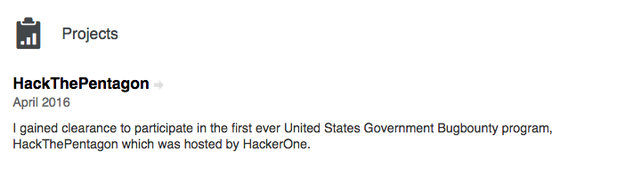
Justin Liverman, who goes by the handle “D3F4ULT,” according to a press release by the US Attorneys Office for the Eastern District of Virginia, states on his LinkedIn page that he participated in the HackThePentagon program.

A screenshot from Justin Liverman&;s LinkedIn profile.

HackThePentagon was a so-called “bug bounty,” a program by which hackers are paid, often by a third party, to find cybersecurity flaws in a company or organization. The company HackerOne administered this particular bounty; according to a blog post, the company accepted 1,400 hackers into the program, and they found 138 “valid bugs.”

“No organization is so powerful that it does not need outside help identifying security issues, and this includes the Pentagon,” wrote HackerOne CEO Mårten Mickos at the conclusion of the program, which ran from April to May 2016.

HackerOne would not confirm or deny whether Liverman participated in its HackThePentagon program. However, requirements for gaining clearance to submit to the bounty were lax. To qualify, hackers had to be US persons and couldn’t appear on the US Treasury Department&039;s Specially Designated Nationals list of people and organizations engaged in terrorism, drug trafficking and other crimes, according to a Department of Defense press release.

According to the government statement released today, Liverman is alleged to be part of the so-called “Crackas with Attitude” hacker collective that over the past year “used &039;social engineering&039; hacking techniques, including victim impersonation, to gain unlawful access to the personal online accounts of senior U.S. government officials, their families, and several U.S. government computer systems.”

Among those government officials was CIA Director John Brennan, whose personal email account was hacked. That attack, reported in October 2015, came seven months before Liverman, according to his LinkedIn post, was accepted into the government-authorized program to hack the Department of Defense. That program was conceived by the Defense Digital Service, the Defense wing of the White House&039;s Digital Service.

Quelle: <a href="Guy Who Allegedly Hacked CIA Director: I Participated In Government Program To Hack The Pentagon“>BuzzFeed

Your Guide to ContainerCamp UK

 UK kicks off tomorrow in the heart of London&;s Piccadilly and we can hardly contain our excitement. There are loads of talks that you won’t want to miss!
 
Thursday, September 8th   
 
Ben Hall, co-organizer of the Docker London Meetup Group will be speaking at Container Camp Day 0, a joint event put on by the Docker London and Kubernetes London Meetup Groups. Tickets are free but space is already sold out. You can sign up on the waitlist.
Be on the lookout for Docker Captains Elton Stoneman, Benjamin Wooton, Alex Ellis, and Nicolas de Loof who will be in attendance and make sure to say hello.
 
Friday, September 9th
 
9:55 am: Ben Firshman, Director of Product Management at Docker &; Building serverless apps with Docker
Everyone&8217;s talking about serverless right now. For good reason – it&8217;s makes distributed apps much simpler to build, scale, and maintain. In this session, Ben will demonstrate how you can use Docker to mix in serverless techniques &8211; right now &8211; and how serverless is going to change how you build distributed apps in the future.

 
11:15 am: Nishant Totla, Docker Software Engineer &8211; Orchestrating Linux containers while tolerating failures
Management of containers in production requires special care in order to keep the application up and running. In this session, learn the mechanisms and architecture of the Docker Engine orchestration platform (using a framework called swarmkit) to tolerate failures of services and machines, from cluster state replication and leader-election to container re-scheduling logic when a host goes down.

 
12:35 pm Lightening Talk: Nicholas Deloof &8211; Continuous delivery in a container world
 
5:00 pm: DockerCaptain Alex Ellis &8211; Docker and IoT: securing the server-room with realtime ARM microservices
Docker and Raspberry Pi are the perfect combination for protecting the data center against thermal overload and tampering. Learn how Docker Captain Alex Ellis used off-the-shelf hardware to create a scalable solution with help from Pimoroni and Docker Swarm.


Your docker agenda 4 containercamp w/ @bfirsh @nishanttotla @ndeloof @alexellisuk Click To Tweet

The post Your Guide to ContainerCamp UK appeared first on Docker Blog.
Quelle: https://blog.docker.com/feed/

View Information About Committed Code Changes in AWS CodePipeline

You can now view details and information about code changes flowing through your software release pipeline in AWS CodePipeline. This provides you more context about changes that have been committed to your source repository and are running through your pipeline. Viewing this information can be useful when reviewing manual approval actions or troubleshooting failures in your pipeline actions.
Quelle: aws.amazon.com