How To Beat Uber’s Surge-Pricing Algorithm (And Lyft’s Too)

Uber surge pricing, Lyft Prime Time: Call it what you will, but it&;s never fun to fire up a ride-hailing app when you&039;re in a hurry only to discover that everyone else is in a hurry too — and your ride is going to cost more because of it.

Surge pricing is almost always a nasty surprise. And it&039;s widely loathed by ride-hail passengers — so much so that in January, Uber said it was moving away from surge multiplier notifications (like “3.0x the normal fare”) and instead showing prospective passengers the estimated total cost of their ride before its request. That makes it easier to avoid situations like this:

instagram.com

But surge pricing can still be frustrating, even if you know the cost of your ride in advance. Below, we&039;ve gathered a few handy tips and tactics for avoiding it, from the quick and dirty to some that require a bit more planning and effort.

Check the ride-hailing tab in Google Maps.

Priya Anand / BuzzFeed News

Google integrated Uber into its Maps service back in 2014. Earlier this month, it added Lyft and a handful of other ride-hail companies. Today, you can use Google Maps to compare estimated fare ranges and trip times for nine ride-hail companies across more than 60 countries — no need to fire up each app individually.

Schedule Lyft rides in advance.
Priya Anand / BuzzFeed News

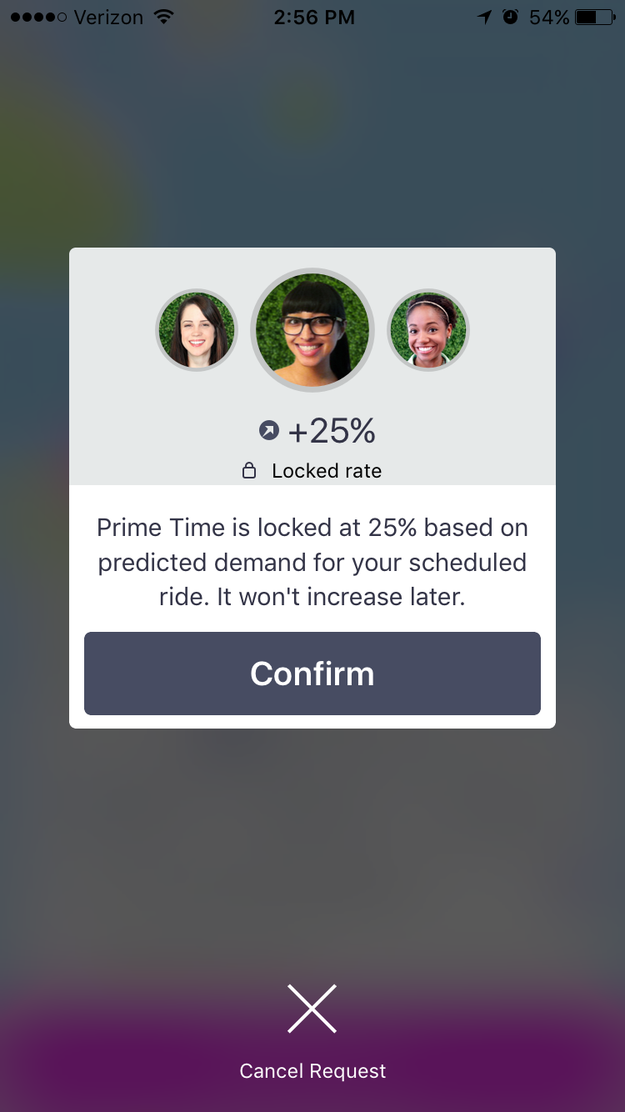
Uber and Lyft recently began rolling out a feature that allows passengers to schedule their trips in advance. Uber says these rides are subject to the pricing conditions at the time — including surge multipliers. But Lyft locks in your price if you schedule a ride in advance. The company&039;s estimate does account for whether or not your ride will occur during “Prime Time,” for example, if you schedule a pickup during rush hour. But beyond that, the rate is set and you aren&039;t susceptible to additional price hikes if demand increases further. You must schedule the ride at least 30 minutes or up to 7 days ahead of the pick-up time.

Wait it out — or walk a few blocks — and try again.

In a 2015 study, researchers at Northeastern University found that passengers with some free time on their hands have a reasonable chance of escaping Uber&039;s surge pricing simply by waiting it out — or by moving beyond the surge zone. They ran 43 versions of the Uber app pretending to be people in various parts of each city, and found that cities are divided into surge areas that look like this:

Courtesy of Christo Wilson

They also found that surge prices change frequently. “Theres a 60% chance the price is not going to stay high for more than five minutes,” Christo Wilson, who led the Northeastern team, told BuzzFeed News. “If you happen to be standing at a location that&039;s right between the border … you can actually get different prices just by walking across it.”

But that advice comes with a caveat: You could end up walking deeper into a surge zone. “The easiest thing is just to wait,” Wilson said. “If it&039;s not rush hour — or last call, when all the bars close simultaneously — the rest of the time if you see a surge, it&039;s ephemeral. It will go away.”

Try apps like SurgeProtector.

SurgeProtector, which launched in 2014, claims to take the guesswork out of gaming Uber&039;s surge. It uses Uber&039;s API to find locations close to you with lower surge pricing. Simply drop a pin and move it around to locate a surge-free locale. Reviews are mixed; SurgeProtector has three stars in the iTunes Store.

Download the driver apps.

If you&039;re really dedicated to saving your hard-earned cash, apply to drive for Uber and Lyft and then download their driver apps. Both use heat-map visualizations to show areas of heightened demand where fares will temporarily rise. In order to access these driver apps, you&039;ll have to share a bit more of your personal information with each company. But hey, you&039;re already giving them your credit card number, contact information, and location anyway.

Quelle: <a href="How To Beat Uber’s Surge-Pricing Algorithm (And Lyft’s Too)“>BuzzFeed

Oracle UTL_Mail and July 2016 PSU Patches are now available for Amazon RDS for Oracle

You can now send email directly from your RDS for Oracle databases by using the UTL_MAIL package. To enable UTL_Mail for your DB instance, you need to create a new option group, or copy or modify an existing option group and add the option Oracle UTL_MAIL to it. You then need to associate this option group to your DB instance either by selecting the option while creating a new instance or while modifying an existing instance. Right now, we only support single attachments up to 32KB in size and only ASCII and EBCDIC character encodings. Amazon RDS supports UTL_MAIL for the Oracle version 12.1.0.2.v5 and later, 12.1.0.1.v6 and later and 11.2.0.4.v9 and later. These versions include the July 2016 Oracle Patch Set Updates (PSU).  
Quelle: aws.amazon.com

Bletchley – release & roadmap – Cryplets deep dive

In the introduction of Project Bletchley white paper in June, we introduced some of the requirements needed for building consortium-based blockchains as well as Cryptlets, a primitive for next generation blockchain applications. Today, I&;m proud to announce the release of Bletchley v1 and the next level of detail regarding the roadmap of features for Cryptlets.

Bletchley v1 is the release of the first consortium blockchain template that allows customers and partners to spin up a private consortium Ethereum network from a handfull of nodes to 100s of nodes in the network.  It reduces the estimated 3 week process of setting up a globally distributed multi-node consortium Ethereum network down to 8 questions and 5-8 minutes.  Not only does Bletchley v1 automate the setup of the network infrastructure but it sets up a portal for rapidlly getting started developing applications on Ethereum.

Additionally, more information about the roadmap for Bletchley with details about Cryptlets is available here. Cryptlets are building blocks for a new layer of capability we are calling the Cryptlet Fabric, where these components can be developed, published and accessed in a standard way.  They will be discoverable within developer, architect, and business process modeling tools for easy use and can be created with an SDK to expose your own logic for reuse and sale.  

Cryptlets provide a common and approachable way for developers to use cross cutting capabilities like integration into existing systems, secure execution and data, privacy, scalability in programming languages enterprise developers use most.  Microsoft Azure offers a world wide footprint that will allow Bletchley to offer a hyper-scale secure data and execution platform to help build the next generation applications on any blockchain platform.

Click here to view the Bletchley Roadmap – Cryptlet Deep-Dive Features and Behaviors.
Quelle: Azure

Amazon API Gateway introduces 3 new features to simplify API configuration

Amazon API Gateway now supports three new features that make it easy to integrate APIs with AWS Lambda and HTTP endpoints. Previously, you needed to define each method and its integration behavior in API Gateway in order to integrate with backend endpoints. Now, you can route all traffic to a specific backend endpoint without having to apply any request or response mappings and transformations.
Quelle: aws.amazon.com

Amazon Elastic Transcoder Now Publishes Operational Metrics to Amazon CloudWatch

You can now monitor, alarm and receive notifications on the operational performance and usage of Amazon Elastic Transcoder using Amazon CloudWatch. Amazon CloudWatch is a monitoring service for AWS cloud resources and the applications you run on AWS. Amazon Elastic Transcoder now automatically publishes nine operational metrics into Amazon CloudWatch, giving you more visibility into the overall health of your transcoding workflow and the ability to invoke an action if the metric you are tracking crosses a certain threshold for a defined period of time. You can monitor metrics such as jobs completed, jobs that errored out, output minutes generated, standby time, and errors and throttles on various API calls. 
Quelle: aws.amazon.com

The Algorithm That Predicts What The Ultra-Wealthy Want

The pool at the Beverly Hills Hotel.

The Dorchester Collection

A computer told Ana Brant that the ultra-rich care deeply about their breakfast options. This came as a surprise.

Brant is the director of guest experience and innovation for the Dorchester Collection, a hotel group that counts among its properties the Beverly Hills Hotel, the Hotel Eden in Rome, and Le Meurice in Paris, where rooms start at $780 a night and wind their way up to over $16,000 for the Belle Etoile (“beautiful star”) suite. Her job, which she describes on LinkedIn as “the science of luxury service,” is to listen to the very wealthy people who stay in her company&;s hotels, so they keep staying there instead of, say, the Peninsula, the St. Regis, or the Mandarin Oriental.

Hotels of this kind throw mountains of money at celebrity chefs to build fine dining destinations. Dinner is the main event. Breakfast is often an afterthought. And yet here was big-data proof — delivered by machine learning software called Metis, which analyzes online customer reviews — that Dorchester Collection guests write way more about breakfast in their reviews than dinner.

The algorithm found that the ultra-wealthy actually do like the idea of a buffet — but only if it comes in the form of a waiter who says he can make anything.

Metis also found that guests loved to customize their breakfasts; they were, as Brant put it, “looking at breakfast menus as an inspirational list of ingredients.” So she went to her chefs. It turned out Metis was right: Dorchester kitchens reported that somewhere between 80 and 90% of breakfast orders are modified.

So today, when you sit down to breakfast at the Beverly Hills Hotel (which has 1,019 reviews on TripAdvisor, 298 on Booking.com, 235 on Yelp, and 294 on Expedia), a waiter comes up to you and asks what you want — they&039;ve got everything. No menu.

“Guests love it,” Brant said. “It&039;s a Hollywood crowd. Everyone has their own diet.”

And it&039;s all because of an algorithm, one that could signal a new way for customer service businesses to study their clientele: through the collection and analysis of their own words.

In the past, luxury businesses have had to rely on “secret shoppers” and customer feedback forms to improve their service. Now, Metis is taking the massive trove of consumer data on customer review sites like TripAdvisor and Booking.com and turning it into market research that will tell businesses what their elite clients want, before they know they want it. It began with a little bit of customer feedback. Around five years ago, as review sites started to flourish, David and Kyle Richey, who for nearly four decades have run the luxury consulting firm Richey International, noticed that their clients were aghast.

“Hotels that we were dealing with were starting to feel overwhelmed by the amount of data that was coming at them,” said Kyle Richey.

Hotels didn&039;t know how to handle the sheer volume of feedback on the sites and saw it as a headache. But the Richeys — whose clients include the Ritz Paris, Viking River Cruises, and the NFL — saw it as a potential source of value. “We realized that there is rich content within the reviews, but everyone was using them for PR value,” Kyle Richey said. “No one was using them for operational value or strategy, because it&039;s hard to read thousands of reviews and find the trends.” In other words, businesses were slapping positive Yelp reviews on their windows, not using the feedback to improve.

The Hotel Bel Air&039;s Swan Lake.

The Dorchester Collection

In 2013, the Richeys started meeting with text analytics firms in the Bay Area, where they&039;re based, to develop a way to turn reviews into advice. But all of the firms&039; proposals were overly complex. So they hired their own engineers to write machine learning software that could look for words and phrases that correlate with important customer service metrics like emotional bond and loyalty. Then they turned that software over to Werner Koepf, the senior vice president of engineering at Conversica, which makes AI for marketing and sales, to build a web app that their clients could use.

Finally, after two years and several million dollars of their own money, the Richeys were ready to demo Metis. Brant, their first client, was bowled over.

“I thought, Oh my goodness,” Brant said. “This is going to be the most amazing thing ever.

In June 2015, Brant took a Metis demo comparing six ultra-luxury hotels in New York to a meeting of Dorchester Collection general managers in LA. The managers were impressed, particularly by a finding that a “super iconic and amazing hotel had a serious issue with leadership — people were running away when a customer complained.” They approved a Metis study on the spot.

So the Richeys ran Metis on over 8,000 TripAdvisor reviews, some on Dorchester hotels and some on competitors. That&039;s what led Brant to the realization that the ultra-wealthy actually do like the idea of a buffet — choosing exactly what they want — but only if it comes in the form of a waiter who says he can make anything.

“If you want to continue to be a true luxury, you have to figure out a way to draw insights that no one has ever had.”

Metis&039;s findings went further than breakfast. The analysis found that words related to relaxation and unwinding were closely correlated with words related to emotional bond and loyalty (words like “recommend” and “return”). In reviews of the Dorchester-owned Hotel Bel-Air, the software found that guests frequently mentioned words like “relaxation,” “unwinding,” and “pampered” alongside descriptions of patios, terraces, and fireplaces. Brant realized that photos on the hotel website didn&039;t emphasize the rooms&039; outdoor features — a situation she quickly changed. Now the Dorchester Collection places Google keyword bids on words such as “fireplace” and “terrace.” (Companies pay Google for ads to show up next to search results for certain words.)

If the changes prompted by Metis seem granular — some music in the hotel bar here, an easily selfied vantage point there (“If the customer can’t insinuate himself into the view, it doesn’t exist,” said David Richey) — that&039;s sort of the point. The hidden desires of ultra-high-end hotel customers, who are used to an extraordinarily high standard of service, come down to the details. Differentiation happens at the margins.

“If you want to continue to be a true luxury,” Brant said, “you have to figure out a way to draw insights that no one has ever had.”

Yes, luxury hotels now have at their disposal a computer program that can divine the small details to lure the, as Brant put it, “C-suite executives, A-list celebrities, fashion executives, politicians, and notable businessmen” away from their competition.

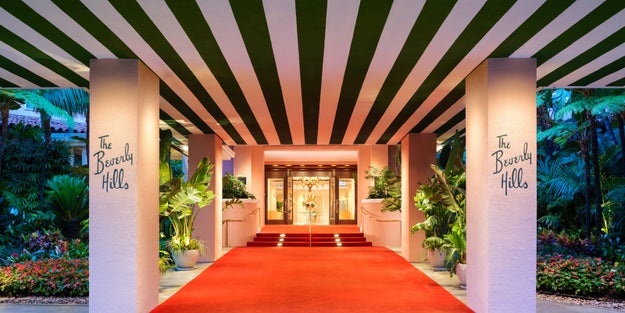
The red carpet at the Beverly Hills Hotel.

The Dorchester Collection

And who, exactly, will be drawing these insights and adjusting these details? So far, the Richeys have used Metis for about 15 clients, including Viking River Cruises and a “major sports league.” That&039;s not for lack of demand: Kyle Richey said Metis has received “strong interest from major brands, including a very well-known Swiss jeweler.” The Richeys stressed, though, that the tool is in its early days and that they want to proceed slowly.

That said, their goals are huge. “My hope is that it will change the nature of market research,” Kyle Richey said.

That would mean, presumably, broadening Metis&039;s use past luxury industries and into the larger world of customer service. Could we one day soon see major changes to the Cheesecake Factory and Foot Locker based on an algorithm&039;s analysis of thousands of online reviews?

Perhaps, but don&039;t ask Ana Brant.

“I&039;ve always been in luxury,” Brant said. “I&039;m not sure what triggers the masses.”

Quelle: <a href="The Algorithm That Predicts What The Ultra-Wealthy Want“>BuzzFeed

Data Factory supports multiple web service inputs for Azure ML Batch Execution

For orchestrating workloads on Azure ML (Machine Learning) batch execution web services, Azure Data Factory supports a built-in activity, namely Azure ML Batch Execution activity. Customers can leverage this activity to operationalize their ML models at scale.

Little while ago, Azure ML added support to allow multiple Web Service Inputs for a given experiment. Consequently, customers have been looking to leverage this capability through Azure Data Factory. Data Factory now supports configuring the ML Batch Execution Activity to pass multiple Web Service Inputs to the ML web service.

Suppose you have an Azure ML experiment which accepts more than one Web Service Input.

Note the names of the created Web service inputs, as you must use these names when specifying the endpoints in your Data Factory Pipeline. The name can be found in the Properties pane of the module. By default the first Web Service Input module you create will be named “input1,” the next one “input2,” and so on. If you rename the modules, be sure to update the names in the webServiceInputs property in your Data Factory pipeline accordingly.

In your Azure Data Factory Pipeline, you can use the new WebServiceInputs property instead of the existing WebServiceInput property to specify the inputs into your experiment. 

"typeproperties":
{
"webServiceInputs":
{
"trainingData": "NameOfInputDataset1",
"scoringData": "NameOfInputDataset2"
},
"webServiceOutputs":
{
"output1": "NameOfOutputDataset"
},
"globalParameters": {}
}

For more information on the Azure ML Batch Execution activity in Azure Data Factory, refer to this documentation page.

If you have any feedback on the above capabilities please visit Azure Data Factory User Voice and/or MSDN Forums to reach out. We are eager to hear from you!
Quelle: Azure