After Reporting Abuse, Many Twitter Users Hear Silence Or Worse

BuzzFeed News

The first time Priyanka Singh suffered the wrath of Twitter’s brutish underbelly, she cried herself to sleep. A 27-year-old from Delhi working in education publishing, Singh is also an atheist and an outspoken critic of India’s casteism and rape culture — a choice she pays dearly for in her Twitter mentions. Her abuse on the platform began in February and in the ensuing months has become routine: rape threats, body-shaming, egg-avatared strangers wishing her and her family harm.

The harassment took a toll. “I became aggressive online and defensive at home,” Singh told BuzzFeed News. Her relationship with her then-boyfriend deteriorated as she obsessed over the vitriol and invective directed at her on Twitter. It consumed her time, her energy. At work, Singh was preoccupied and easily agitated. When a troll alerted her employer to some of her tweets, her colleagues and managers urged her to delete her account, suggesting that Twitter “wasn’t real life.” Clearly, fighting back wasn’t helping.

“It only adds to the humiliation when you pour your heart out and you get an automated message saying, &;We don&039;t consider this offensive enough.’”

Meanwhile, on Twitter, Singh was a “cunt.” Or a “feminazi” or a “whore and jihadi.” When her Twitter tormentors discovered Singh had been diagnosed with bipolar disorder, they attacked her for that, too, tweeting, “Your brain is fucked up.” Eventually Singh began cataloging her abuse. She diligently took screenshots of the harassing tweets and reported them to Twitter. Each time (save for once in August when Twitter suspended a lone tormenter’s account), the company’s response was the same: “We’ve investigated the account and reported tweets for violent threats and abusive behavior, and have found that it’s currently not violating the Twitter rules.” Singh was devastated. “It only adds to the humiliation when you pour your heart out and you get an automated message saying, &039;We don&039;t consider this offensive enough,’” she said.

So, like countless victims of harassment, Singh stopped trying. She made the tedious task of troll-blocking part of her daily routine, and tried to shrug off the abuse.

And on Twitter, the trolls kept on trolling.

BuzzFeed News asked some survey respondents to share their Twitter harassment experiences. Click the embedded posts to hear their stories.

Over a decade into Twitter’s existence, harassment of the sort Singh suffered is a well-documented and common practice on the platform. But Twitter’s protocols for reporting abuse and addressing it remain largely opaque. Until 2014, simply reporting abuse was a cumbersome process, requiring users to fill out an arduous, but thorough nine-part questionnaire. Today, the process is somewhat more streamlined. Users can now report abuse they see on behalf of others, and in April of this year the service finally allowed users to report multiple tweets at once. But despite these tweaks, countless targets of abuse have found that their reports — no matter how vile their content — don’t meet Twitter’s standards for harassment. Users receive no justification besides a “thank you” and a prompt to contact law enforcement if they feel they are in danger.

Take Kelly Ellis. Ellis, a software engineer at Medium with a verified account and over 11,000 followers, was mercilessly tormented by a single Twitter user for weeks this past summer. By the time her antagonist, @fredcarson9151, concluded his 70-tweet barrage of abuse, Ellis had listened to her accuser publicly express a desire for her to be raped. She’d also been berated as a “psychotic man hating ‘feminist’” and told that “men don’t need her opinion” on matters of sexual assault.

Ellis reported the abuse and Twitter investigated it. But the conclusion of the company&039;s investigation was perplexing. Ellis said Twitter told her that the behavior she reported did not violate its rules, which explicitly state that one may not “threaten other people on the basis of race, ethnicity, national origin, sexual orientation, gender, gender identity, religious affiliation, age, disability, or disease.” BuzzFeed News documented Ellis&039;s experience in a story widely shared across social media. Two hours after its publication, @fredcarson9151 was banned from Twitter.

Singh and Ellis’s stories are common; despite vigilantly reporting abuse to Twitter, countless victims of harassment allege they see little in the way of an effective response from the company. Attacks recur, mentions remain toxic. To better understand how Twitter handles reports of harassment, BuzzFeed News invited readers to complete an online survey about abuse. More than 2,700 users responded. The results suggest that an overwhelming majority of reported abuse requests ended with Twitter taking no visible action toward the offending account.

Before we dig into the results, a few important caveats: Our survey was distributed primarily through BuzzFeed’s social channels, largely on Twitter and via a link in a BuzzFeed News post. As such, the 2,702 respondents are likely not reflective of Twitter’s users overall. Respondents who participated in this survey were largely English-language speakers. By virtue of the subject matter, participants were probably more likely to have experienced abuse on Twitter than the average user of the service. (That said, respondents were given an option to state that they had not experienced abuse on Twitter.) BuzzFeed News also conducted follow-up interviews with a number of respondents.

Also worth noting: We&039;ve seen evidence that Twitter occasionally takes action against tweets reported as abusive without revealing that it has done so. But this leaves targets of abuse who reached out to the company in the dark about whether their appeals for help were heard. In some instances, Twitter has publicly revealed that it deleted tweets after a high-profile outcry. Just yesterday, Binyamin Appelbaum, a New York Times correspondent with more than 40,000 followers, retweeted some particularly horrific anti-Semitic remarks that had been directed at him and copied Twitter&039;s CEO, Jack Dorsey. Afterward, the company deleted the tweets and Dorsey notified Applebaum of the deletions publicly on Twitter.

All this said, the responses to our survey do offer a human window into Twitter’s underbelly of abuse, providing not only harrowing examples of harassment, but data on how it is handled — or not — by the social network.

According to survey respondents, Twitter’s most common response to an abuse report is inaction. Roughly two-thirds of people BuzzFeed News surveyed who’d received an abusive tweet said they logged it via Twitter’s violation reporting page; nearly 80% of our respondents said they reported an abusive tweet on behalf of somebody else. But very few reported ever receiving a response from the company.

46% of respondents told BuzzFeed News that the last time they reported an abusive tweet to Twitter, the company took no action on their request; their only recourse was to personally block the offending account. Another 29% who reported abusive tweets said they never heard anything back at all. And 18% of those who reported an abusive tweet said they were told that the tweet did not violate Twitter’s rules, which explicitly forbid violent threats, harassment, and hateful conduct. In just 56 instances (2.6% of the time) respondents said Twitter deleted the offending account, and in 22 instances (1% of the time) respondents said Twitter issued a warning to the user who’d sent the tweet. Of the 2,115 people who responded to this particular survey question, just five individuals reported being contacted by a Twitter representative to discuss the abuse they reported.

“Safety is our top priority”

On Sept. 15, Twitter declined BuzzFeed News&039; request for an executive interview on the subject of harassment. In response to a Sept. 19 letter detailing the findings of our survey, Twitter&039;s head of communications, Kristin Binns, provided the following comment:

“Safety is our top priority — we&039;re building better tools and processes every day. We can&039;t comment on a third-party survey, and its anonymous nature makes it impossible to verify data or corroborate response. While we know there’s still much to be done, we’re making progress toward giving people more control over their Twitter experience and to better combat abuse.”
BuzzFeed News

Of our 2,702 respondents, 1,478 (55%) said they had been the target of an abusive tweet or Twitter direct message. Of those who answered yes, 18% said they had been harassed in just the past week, while 26% said they had been harassed at some point within the past month, but not the past week.

Examples of harassment from those surveyed frequently appeared to violate Twitter’s rules, which prohibit tweets involving violent threats, harassment, and hateful conduct. Twitter’s rules explicitly state that one may not “threaten other people on the basis of race, ethnicity, national origin, sexual orientation, gender, gender identity, religious affiliation, age, disability, or disease.” Some examples — which were submitted anonymously to BuzzFeed News via our survey — include:

  • “Someone spread a video around of an unnamed girl taking part in perverse activities with an animal, and captioned it with my underage friend&039;s name. It was taken down the next day, but the damage was done.”
  • “Someone took a google cached but long deleted photo of me from my fb, photoshopped it on to a naked body, and posted it alongside my real name, openly calling me a dyke (I&039;m not out to anyone except a few very close friends). That&039;s one instance in a series of nearly 500 abusive tweets from 50 different troll accounts (likely created by same person or few people, based on how they were posting).”
  • “I get a lot of messages threatening rape, men trying to find my physical location and disseminating it so I can be raped, threats of murder, people wishing miscarriages on me, to be sent into war zones to be raped and murdered.”
  • “Pictures of my family, my address, my employer, threats to &039;rape this bitch with a cactus,&039; threats to &039;take a crowbar to that pretty throat,&039; insinuations that I am only academically successful in a male-dominated subject because I am attractive.”
  • “A map to my home was circulated. There&039;s nothing left of my life for them to dox.”
  • “After a witty retort (that was polite) and me wishing him a good day he said &039;what would make his day better would be to do this&039; and inserted a graphic video of a jihadist chainsawing a kneeling man&039;s head off.”
  • “A picture of a person pointing a gun at me; telling me they&039;d bury me out back; calling me a cunt and telling me to stop talking out of my clit; posting my full name (I am anonymous on Twitter… or was).”
  • “My meant to be private pictures (nudes) posted for months non stop, my drivers license posted, my address posted, my work place address posted, my parents info posted, threats to kill me and my kids, Photoshopped pics of me with gunshot wounds through my head and chest, inciting people to swat me, my naked pics tweeted at two workplace Twitter accounts, it goes on and on. Pedophile tweets about my kids.”

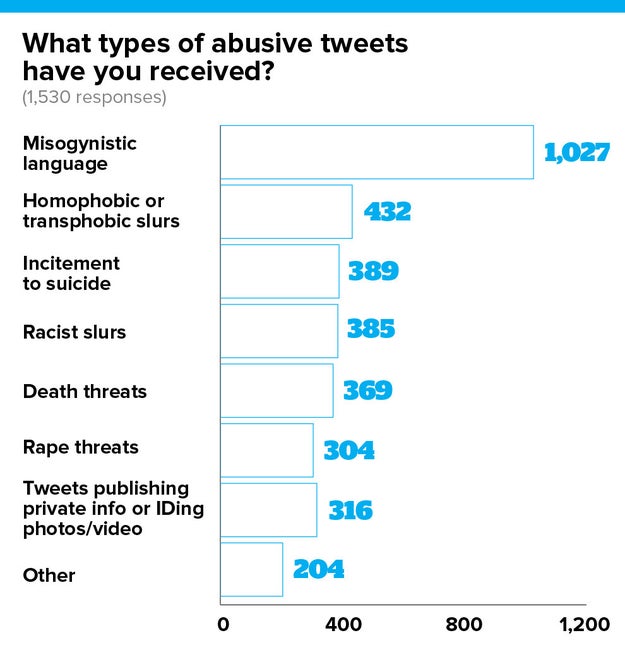
As the above examples demonstrate, respondents of the BuzzFeed News survey reported experiencing a broad spectrum of targeted abuse on Twitter. Over 67% of respondents described the tweets they received as misogynistic in nature. Nearly 30% reported being targeted with homophobic slurs. One-quarter said they’d been subjected to racist epithets, one-quarter reported death threats, and one-quarter reported tweets encouraging them to kill themselves.. Nearly 20% of respondents reported being threatened with rape; another 20% said they’d received tweets threatening to publish their private information, photos, or videos.

While the examples vary in frequency and severity, the trauma of abuse in combination with Twitter’s response as described above has created a growing feeling of futility among BuzzFeed News survey respondents. “[Twitter] can be presented with multiple examples of a user violating [terms of service] and STILL say the account broke no rules,” one wrote. “It&039;s disheartening. You feel utterly vulnerable. I&039;ve never been so afraid to upset the wrong person.”

“They care more about copyrights than they do about people.”

“Twitter claims to be balancing concerns for free speech with comfort of users, but the fear of harassment … or even worse, doxxing routinely causes me to self-censor,” one wrote. Another respondent agreed: “In essence, Twitter&039;s protection of hate speech in the guise of free speech infringes on my own free speech.” The self-censoring effect can create a culture of fear for frequent harassment targets like women and people of color. “While I personally haven&039;t been harassed, I HEAVILY censor what I say on Twitter because I&039;ve seen how abusive people are towards women there,” one respondent wrote.

Other respondents suggested that Twitter’s harassment problem is systemic and worsening. “Having been on Twitter since it started, I have seen a drastic change in the past year, especially in terms of harassment. It has become &039;normal,&039; almost the purpose of the platform itself,” one wrote. “There seems to be absolutely no way to take action against it. Reporting used to have some impact, lately I don&039;t even get responses to reports,” said another.

Particularly frustrating for users is Twitter’s penchant for quickly taking down content that violates copyright for its media partners. This summer, victims of Twitter abuse criticized the network for suspending accounts posting Olympics-related content without permission while not responding to their claims of user abuse. “[Twitter] took down a video I posted about the Olympics about 12 hours after I published it. But it has never taken down a harmful tweet or an account reported by me,” one respondent said about the apparent double standard. “They can delete accounts sharing broadcast content in minutes, but abusers are rarely if ever sanctioned, and almost never banned,” a second surveyed user wrote. Others surveyed were more blunt: “How much money do I need to have to protect myself and my friends? Olympics money? NBC money? Taylor Swift money?” And: “They care more about copyrights than they do about people.”

Though the hundreds of written responses collected by BuzzFeed News vary, a majority of those surveyed expressed concerns about Twitter’s internal commitment to abuse and to the platform’s average, non-celebrity users. For many surveyed, years of inaction have led to a lack of trust on behalf of victims of harassment and an expectation that the problem, now systemic, will never be resolved. “The only thing I get from reporting people is the knowledge that I took an action to stop it,” one user told BuzzFeed News. “I don&039;t expect anything back from Twitter anymore, they don&039;t care.” Another respondent suggested that “[harassment is] just clearly something that Twitter has grown to tolerate, despite what they might say, which is wrong and it only fuels hate.” While a third summed up their experience by saying, “I constantly feel disrespected by Twitter, as they ignore threats made against me, but have the resources to support me.”

“I love Twitter and won&039;t leave, but many others just can&039;t carry on with the abuse they get.”

Despite the vitriol, some respondents still expressed affection for the platform. “I love and use Twitter every day, since 2010, but I definitely have never thought that Twitter has taken harassment seriously,” one respondent wrote. Others are worried that the lack of improvement could lead to the eventual silencing of some of Twitter’s most vital members. “It&039;s out of control and delegitimizing Twitter as a channel. I don&039;t want to lose the diversity of voices, but can&039;t imagine some people staying on the platform given how they are treated. It has also allowed racism and misogyny somehow become openly tolerated.”

Repeat abuse victims are left with a bitter choice: stay and be repeatedly targeted or leave the network and all the connections behind. As Ellis noted, the decision to leave is not only a victory for Twitter’s most vile communities, but also effectively silences the voices of some of its marginalized users. And in cases where Twitter is vital to the the jobs and well-being of others, it is a painful alienation. “It sucks having to choose between feeling safe & avoiding vitriol w the ugliness of rape, vs keeping social connections that matter to me,” Ellis tweeted after Twitter rejected her abuse reports on the grounds that her harasser did not violate the company’s rules.

For Twitter, which has long struggled with user growth issues, its failure to handle abuse reports could drive away some of its most passionate power users. “It&039;s ruining the platform,” one survey respondent noted. “I love Twitter and won&039;t leave but many others just can&039;t carry on with the abuse they get.”

You&039;ll find full responses to our survey below.

Quelle: <a href="After Reporting Abuse, Many Twitter Users Hear Silence Or Worse“>BuzzFeed

90% Of The People Who Took BuzzFeed News’ Survey Say Twitter Didn't Do Anything When They Reported Abuse

That Twitter is plagued by harassment is a truism. Innumerable blog posts and stories have been written about the company&;s endless struggle against hate speech and the trolls who propagate it. Yet Twitter’s reporting process for such behavior remains opaque, and countless people who’ve been targeted by it say reports they filed with Twitter were ignored or dismissed because they didn&039;t meet the company’s standards for harassment.

To better understand how Twitter handles reports of harassment, BuzzFeed News invited readers to complete an online survey about abuse. More than 2,700 users responded. The results suggest that an overwhelming majority of reported instances of abuse ended with Twitter taking no visible action toward the offending account.

But first, a few things to keep in mind:

Our survey was distributed primarily through BuzzFeed’s social channels, largely on Twitter and via a link in a BuzzFeed News post. As such, the 2,702 respondents are likely not reflective of Twitter’s users overall. Respondents who participated in this survey were largely English-language speakers. By virtue of the subject matter, participants were probably more likely to have experienced abuse on Twitter than the average user of the service. (That said, respondents were given an option to state that they had not experienced abuse on Twitter.) BuzzFeed News also conducted follow-up interviews with a number of respondents.

Also worth noting: We&039;ve seen evidence that Twitter occasionally takes action against tweets reported as abusive without revealing that it has done so. But this leaves targets of abuse who reached out to the company in the dark about whether their appeals for help were heard. In some instances, Twitter has publicly revealed that it deleted tweets after a high-profile outcry. Just yesterday, Binyamin Appelbaum, a New York Times correspondent with more than 40,000 followers, retweeted some particularly horrific anti-Semitic remarks that had been directed at him and copied Twitter&039;s CEO, Jack Dorsey. Afterward, the company deleted the tweets and Dorsey notified Appelbaum of the deletions publicly on Twitter.

All this said, the responses to our survey do offer a human window into Twitter’s underbelly of abuse, providing not only harrowing examples of harassment, but data on how it is handled — or not — by the social network.

About our respondents:

Of the the 2,669 people who provided demographic information in our survey:

  • 772 people (26.3%) identified as a racial or ethnic minority.
  • 707 people (28.8%) identified as a member of the LGBTQ community.

Here’s the gender breakdown of the the 2,669 people who chose to answer:

  • 1,817 female
  • 720 male
  • 58 gender fluid
  • 26 transgender
  • 21 agender
  • 27 not listed

THE RESULTS:

Of our 2,702 respondents, 1,478 (55%) said they had been the target of an abusive tweet or Twitter direct message. Of those who reported suffering abuse on Twitter, 18% said they had been harassed in just the past week, while 26% reported being harassed at some point within the past month, but not the past week.

According to survey respondents, Twitter’s most common response to an abuse report is inaction.

46% of respondents told BuzzFeed News that the last time they reported an abusive tweet to Twitter, the company took no action on their request that they were aware of; their only recourse was to personally block the offending account. Another 29% who reported abusive tweets said they never heard anything back at all. And 18% of those who reported an abusive tweet said they were told that the tweet did not violate Twitter’s rules, which explicitly forbid violent threats, harassment, and hateful conduct. In only 56 instances (2.6% of the time) did respondents say Twitter deleted the offending account, and in 22 instances (1% of the time) respondents said Twitter issued a warning to the user who’d sent the tweet. Of the 2,115 people who responded to this particular survey question, just five individuals said they were contacted by a Twitter representative to discuss the abuse they reported.

On Sept. 15, Twitter declined BuzzFeed News&039; request for an executive interview on the subject of harassment. In response to a Sept. 19 letter detailing the findings of our survey, Twitter&039;s head of communications, Kristin Binns, provided the following comment:

“Safety is our top priority — we&039;re building better tools and processes every day. We can&039;t comment on a third-party survey, and its anonymous nature makes it impossible to verify data or corroborate response. While we know there’s still much to be done, we’re making progress toward giving people more control over their Twitter experience and to better combat abuse.”

Among survey respondents, harassment was common and varied.

Over 67% of respondents described the tweets they received as misogynistic in nature. Nearly 30% reported being targeted with homophobic slurs. One-quarter said they’d been subjected to racist epithets, one-quarter reported death threats, and one-quarter reported tweets encouraging them to kill themselves. Nearly 20% of respondents reported being threatened with rape; another 20% said they’d received tweets threatening to publish their private information, photos, or videos.

Roughly one-third of survey respondents who reported receiving an abusive tweet said they reported it to the company using Twitter&039;s abuse forms. And nearly 80% of respondents said they reported an abusive tweet directed at somebody else.

We asked survey respondents to describe the harassment they experienced on Twitter. This is what they told us:

  • “Someone spread a video around of an unnamed girl taking part in perverse activities with an animal, and captioned it with my underage friend&039;s name. It was taken down the next day, but the damage was done.”
  • “Someone took a google cached but long deleted photo of me from my fb, photoshopped it on to a naked body, and posted it alongside my real name, openly calling me a dyke (I&039;m not out to anyone except a few very close friends). That&039;s one instance in a series of nearly 500 abusive tweets from 50 different troll accounts (likely created by same person or few people, based on how they were posting).”
  • “I get a lot of messages threatening rape, men trying to find my physical location and disseminating it so I can be raped, threats of murder, people wishing miscarriages on me, to be sent into war zones to be raped and murdered.”
  • “Pictures of my family, my address, my employer, threats to &039;rape this bitch with a cactus,&039; threats to &039;take a crowbar to that pretty throat,&039; insinuations that I am only academically successful in a male-dominated subject because I am attractive.”
  • “Lots and lots, mostly from Gamergaters. One of the worst problems is that even if I block someone, Twitter still allows them to tweet my handle, so the big Gamergate figures can still regularly send their legions of cretins to make my notifications miserable.”
  • “I blocked the abuser, but after a witty retort (that was polite) and me wishing him a good day he said &039;what would make his day better would be to do this&039; and inserted a graphic video of a jihadist chainsawing a kneeling man&039;s head off.”
  • “A serial racist, doxxer and harasser (who has been suspended once before), somehow connected my professional and private accounts, which have nothing to do with each other, posted my full name and encouraged her 30,000+ followers to go after me (some of who have offered to show up with guns). She has also started harassing my former employers as well as inviting harassment to my best friend, who isn&039;t even on twitter. My professional field is social media and marketing, so her harassing tweets have basically held my professional account hostage as they are forever linked and visible to potential employers.”
  • “I had a user on Twitter stalk me, my family and friends on Twitter and offline. This user has had over 85 accounts suspended. I have all documentation to support my claims including usernames, IP addresses, reports sent to Twitter and the FBI. This person would create fake accounts with my name and others in attempts to harass. He tweeted a picture of my mothers license plate to thousands of his followers…This person is racist, homophobic and despite doxing 15 year old girls and having over 85 accounts suspended he is still allowed to have an account on Twitter where he spews hatred, racism and misogyny.”
  • “My meant to be private pictures (nudes) posted for months non stop, my drivers license posted, my address posted, my work place address posted, my parents info posted, threats to kill me and my kids, photo shopped pics of me with gunshot wounds through my head and chest, inciting people to swat me, my naked pics tweeted at two workplace Twitter accounts, it goes on and on. Pedophile tweets about my kids.”
  • “A picture of a person pointing a gun at me; telling me they&039;d bury me out back; calling me a cunt and telling me to stop talking out of my clit; posting my full name (I am anonymous on Twitter… or was)… all different people at different times. There&039;s been more, but that&039;s it off the top of my head.”
  • “Unsolicited photos of genitals.”
  • “There&039;s so much&; Telling me I deserve my rape. Telling me to kill myself. Threats of hunting me down and killing me and my mom. And tonight I was targeted by a group of trolls. I was told I asked to be raped and then that I was a total victim who faked her disabilities and should be euthanized.”
  • “The site is inundated with neo-nazis. I thought of deactivating my account many times, but I didn&039;t want them to think they could silence me. My neighbors reported trucks in front of my house in the middle of the night. I do not answer my house phone anymore due to abusive calls. A map to my home was circulated. There&039;s nothing left of my life for them to dox.”

Though the hundreds of written responses collected by BuzzFeed News vary, a majority of them express concerns about Twitter’s internal commitment to curbing abuse — particularly abuse directed at the platform’s non-celebrity users. For many respondents, Twitter&039;s failure to address harassment on its platform has created an expectation that the problem, now systemic, will never be resolved. Below are some excerpts from respondents:

  • “It&039;s completely out of control and Twitter is doing nothing about it. I have a friend who is basically stalked by a couple of people, from multiple sock accounts. One gets suspended, five more take its place. They use report bots to get her suspended. It happens over and over and Twitter does NOTHING.”
  • “They can be presented with multiple examples of a user violating TOS and STILL say the account broke no rules. It&039;s disheartening. You feel utterly vulnerable. I&039;ve never been so afraid to upset the wrong person.”
  • “This ONE situation of harassment I am dealing with has affected my career, ability to find work (which I haven&039;t been able to) and I am just one of many. As a platform/business, I can&039;t see twitter lasting very much longer as people leave rather than accept that the company doesn&039;t care about their users.”
  • “Having been on twitter since it started, I have seen a DRASTIC change in the past year, especially in terms of harassment. It has become &039;normal,&039; almost the purpose of the platform itself.”
  • “I always tell my co-workers, ‘If you want to know how racist America is, check my Twitter account.’”
  • “They can delete accounts sharing broadcast content in minutes, but abusers are rarely if ever sanctioned, and almost never banned.”
  • “How much money do I need to have to protect myself and my friends? Olympics money? NBC money? Taylor Swift money?”
  • “It sucks. It took down a video I posted about the Olympics about 12+ hours after I published it. But it has never taken down a tweet or an account reported by me. Not a single one. And I report harmful stuff every other day. (Harmful as in blatant racism/sexism, violent content, harassment or abusive content. As in, according to their guidelines.)”
  • “I get the impression that Twitter has no interest in curbing or preventing harassment and only seems willing to take action if the public backlash may impact their bottom line. Twitter claims to be balancing concerns for free speech with comfort of users, but the fear of harassment (or a harassment dogpile or even worse – doxxing) routinely causes me to self-censor. In essence, Twitter&039;s protection of hate speech in the guise of free speech infringes on my own free speech.”
  • “There seems to be absolutely no way to take action against it. Reporting used to have some impact, lately I don&039;t even get responses to reports.”

BuzzFeed News asked some survey respondents to share their Twitter harassment experiences.

w.soundcloud.com

Click here for our full-length post with full results and more interviews, here.

Quelle: <a href="90% Of The People Who Took BuzzFeed News’ Survey Say Twitter Didn&039;t Do Anything When They Reported Abuse“>BuzzFeed

Nearly 14,000 Uber And Lyft Drivers Sign Union Cards In New York

Lucy Nicholson / Reuters

Nearly 14,000 Uber and Lyft drivers in New York have signed up to join the local branch of the Amalgamated Transit Union, according to a union spokesperson. The group plans to rally at the NYC Taxi and Limousine Commission (TLC) headquarters next week to demand a formal vote on unionizing.

The 14,000 sign-ups exceed the 30 percent threshold that federal regulators say must trigger an official vote, the union says. The cards signed by drivers indicate that they seek ATU membership and authorize the union to act as their collective bargaining agent.

In May, Uber struck a deal with the International Association of Machinists and the independent Freelancers Union to form a new Independent Drivers Guild that would represent their workers. While not an official union, the Guild is open to the 35,000 drivers Uber says it employs in New York.

As a condition of the agreement to form the Guild, the Machinists union promised not to try to formally unionize Uber drivers for five years; both the ATU and the International Brotherhood of Electrical Workers have been actively trying to unionize Uber drivers since last winter.

Uber maintains its drivers are independent contractors, not employees, and therefore do not have the right to unionize, although recent legislation in Seattle affirmed their right to do so.

The ATU&;s Local 1181-1061 branch is the largest chapter of the ATU, representing more than 14,000 transit workers including drivers and mechanics throughout New York City, Westchester, and Long Island. The 190,000-member Amalgamated Transit Union represents city and school bus drivers, subway and ferry operators, mechanics and maintenance workers, among others in the U.S. and Canada.

Drivers will rally at the TLC headquarters in Long Island City on Tuesday, September 27, at 11AM.

Quelle: <a href="Nearly 14,000 Uber And Lyft Drivers Sign Union Cards In New York“>BuzzFeed

Twitter Asks You To Identify Tweets You Don't Like So It Can Hone Its Algorithm

In an apparent attempt to improve the quality of Tweets served up by its timeline, Twitter quietly introduced a new feedback tool that lets users indicate types of tweets they&;d prefer to see less of.

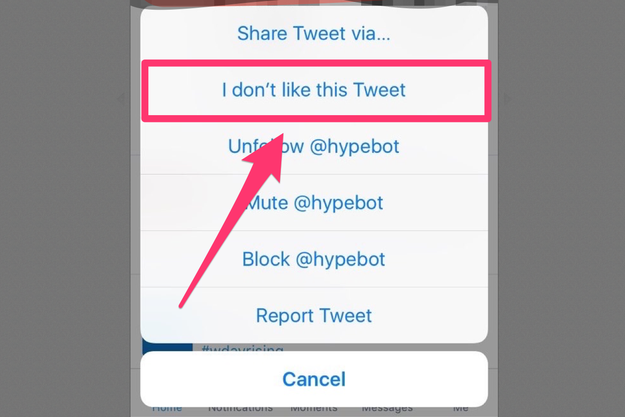
The tool, simply labeled “I don&039;t like this Tweet,” is available in the options menu on individual tweets, and seems geared to help improve Twitter&039;s algorithmic elements. When you click the option, Twitter lets you know that it “will use this to make your timeline better.” Currently, the option is only available for some iOS users.

Reached for comment, a Twitter spokesperson pointed BuzzFeed News to a Twitter Help Center post that says the function “helps Twitter better understand the types of Tweets that you&039;d like to see less of in your Home timeline. We may use this information to optimize and tailor your experience in the future.”

In February, Twitter rolled out what it called an “enhanced timeline,” significantly increasing the prominence of algorithmically selected tweets in its product. Since the rollout, the company said that only 2% of users have opted out from the experience.

Though the new option doesn&039;t indicate plans to expand the program, a more expansive role for the algorithm has been discussed within the company, and given the current program&039;s success, it wouldn&039;t be a surprising if this feedback tool becomes part of something more robust.

Quelle: <a href="Twitter Asks You To Identify Tweets You Don&039;t Like So It Can Hone Its Algorithm“>BuzzFeed

Here's How The Heck iOS 10 Works

Apple&;s latest update for iPhone and iPad can be a little confusing. These tips and tricks will help.

Zoe Burnett / BuzzFeed

The Messages, Photos, and Maps apps got the biggest updates, but there are a lot of new, smaller tweaks throughout iOS 10 that may be causing new users some confusion.

If you&;re wondering what&039;s going on with the home button or where the heck the music controls are now, here are some essential tips and tricks.

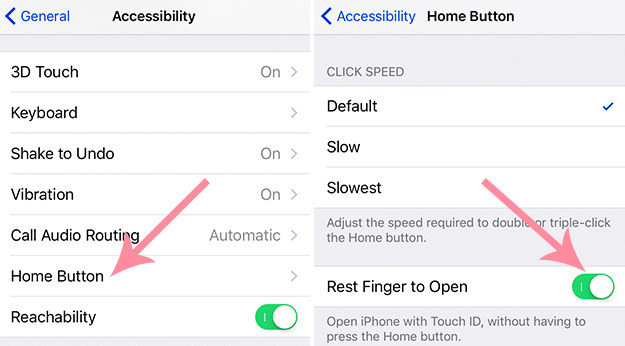
“Slide to unlock” doesn’t exist anymore. You now have to press the home button twice with Touch ID or once to enter in a passcode – but there’s a workaround.

"Slide to unlock" doesn't exist anymore. You now have to press the home button twice with Touch ID or once to enter in a passcode – but there's a workaround.

Go to Settings > General > Accessibility > Home Button > and then slide Rest Finger to Open to enable. This will allow you to open the iPhone with Touch ID, instead of having to press the home button every time.

If you don&039;t have a device with Touch ID (iPhone 5 or older), you&039;ll still need to press the home button to enter your passcode.

Nicole Nguyen / BuzzFeed News

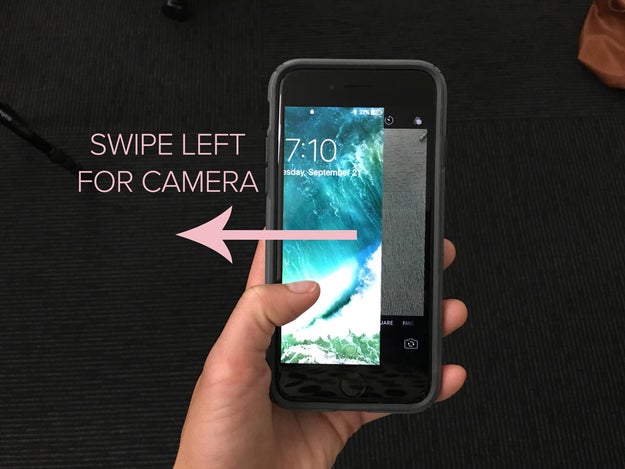
From the lock screen, access the camera by swiping left (instead of up).

From the lock screen, access the camera by swiping left (instead of up).

Nicole Nguyen / BuzzFeed News


View Entire List ›

Quelle: <a href="Here&039;s How The Heck iOS 10 Works“>BuzzFeed

5 Minutes with the Docker Captains

Captain is a distinction that Docker awards select members of the community that are both experts in their field and are passionate about sharing their Docker knowledge with others.

This week we are highlighting 3 of our outstanding Captains who are making September one filled with Docker learnings and events. Read on to learn more about how they got started, what they love most about Docker, and why Docker.
Alex Ellis
Alex is a Principal Application Developer with expertise in the full Microsoft .NET stack, Node.js and Ruby. He enjoys making robots and IoT-connected projects with Linux and the Raspberry PI microcomputer. He is a writer for Linux User and Developer magazine and also produces tutorials on Docker, coding and IoT for his tech blog at alexellis.io.

As a Docker Captain, how do you share that learning with the community?
I started out by sharing tutorials and code on my blog alexellis.io and on Github. More recently I’ve attended local meet-up groups, conferences and tech events to speak and tell a story about Docker and cool hacks. I joined Twitter in March and it’s definitely a must-have for reaching people.
Why do you like Docker?
Docker makes the complex seem simple and forces you to automate your workflow. I have a background in software engineering and automation is everything for delivering reliable, repeatable and testable systems.
What’s a common tech question you’re asked and the high-level explanation?
The questions vary and often surprise me &; I like to be able to connect people to the right Captains or Docker folks. Opening an issue about a technical problem on Github is really valuable for the community and the Docker project. Please give feedback.
What’s your favorite thing about the Docker community?
The community is vibrant and full of life &8211; people are working on solutions for problems that you may have and are generous with their knowledge.
Who are you when you’re not online?
I love film photography &8211; everything from buying vintage cameras, to developing and printing my own images. I balance my time at the screen with road cycling &8211; cruising down country lanes in the countryside or spending just time away from the screen in the great outdoors.
Marcos Lilljedahl
Marcos Lilljedahl is an OS evangelist and Golang lover with a strong background in distributed systems and app architecture. Marcos is currently working at Matica, a Machine Learning startup that brings latest in research to industry. Mantica runs Machine learning apps in a fully dockerized environment mainly using compose / machine and engine.

How has Docker impacted what you do on a daily basis?
Although I run pretty much everything in containers (even games like Counter Strike / Quake3 / etc), the biggest benefit comes from the fact that it really has helped to reduce friction when working with different teams and platforms. It’s a fundamental tool for everyone to speak the same “app” language and then translate that directly into production.
As a Docker Captain, how do you share that learning with the community?
I’m not the “blog post” kind of person, I usually like to deep dive into code and understand the core principles about Docker. I usually contribute by helping people resolve GitHub issues or by responding on the Slack community channel when there are specific questions or unexpected issues. Also, whenever I find some time, I like to hack on stuff like our two hackathon winner projects CMT and Whaleprint.
Why do you like Docker?
What I like the most is its fundamental purpose (help people with great ideas to make things possible) and the community behind it.
Who are you when you’re not online?
I like to do all kind of sports like sailing, swimming, playing soccer, running, snowboarding, roller hockey and crossfit. I also enjoy spending weekends with my girlfriend and family cooking asado.
If you could meet anyone in the world dead or alive who would it be and why?
I would have loved to meet young Steve Jobs. I believe he transmitted the energy to make anyone do the impossible.
Sreenivas Makam
Sreenivas Makam is currently working as a senior engineering manager at Cisco Systems, Bangalore. His interests include SDN, NFV, Network Automation, DevOps, and cloud technologies, and he likes to try out and follow open source projects in these areas. His blog can be found at sreeninet.wordpress.com and his hacky code at github.com/smakam. Sreenivas wrote a book on Mastering CoreOS, which was published in February 2016. He has done the technical reviewing for Mastering Ansible book, Packt Publishing, Ansible Networking Report, O&;Reilly Publisher and Network programmability and Automation book, O&8217;Reilly Publisher. He has given presentations at Docker and other meetups in Bangalore.

How has Docker impacted what you do on a daily basis?
I come from a networking background and used to approach problems from an infrastructure point of view. Docker has given me the insight to approach problems from a developer or an operator perspective.
As a Docker Captain, how do you share that learning with the community?
I enjoy sharing my learning and knowledge through my blogs. Other than this, I give presentations in Docker meetups and other meetups in Bangalore. The best part about being a Docker captain is the direct access to Docker developers and other Docker captains and there is always something new to learn from them.
How did you first get involved with Docker?
I was fascinated with cloud adoption and trying out related technologies like AWS and Google cloud, Openstack and SDN. I dabbled into Docker as part of this. I was initially impressed with how fast I could build, deploy and destroy a Docker container. I got involved in Docker from October 2014 and the first version I used was Docker 1.3.
Why do you like Docker?
There are many reasons, the biggest reason is perhaps the simplicity. There has been a lot of effort put in making complex topics like Orchestration and Security very easy to use for both developers and operations teams.
What’s your favorite thing about the Docker community?
The Docker community is super-active, encourages new members and supports diversity.
Follow all of the Docker Captains on Twitter using Docker with Alex Ellis’ tutorial.
Docker Captains
Captains are Docker ambassadors (not Docker employees) and their genuine love of all things Docker has a huge impact on the Docker community – whether they are blogging, writing books, speaking, running workshops, creating tutorials and classes, offering support in forums, or organizing and contributing to local events – they make Docker’s mission of democratizing technology possible. Whether you are new to Docker or have been a part of the community for a while, please don’t hesitate to reach out to Docker Captains with your challenges, questions, speaking requests and more.
While Docker does not accept applications for the Captains program, we are always on the lookout to add additional leaders that inspire and educate the Docker community. If you are interested in becoming a Docker Captain, we need to know how you are giving back. Sign up for community.docker.com, share your activities on social media with the Docker, get involved in a local meetup as a speaker or organizer and continue to share your knowledge of Docker in your community.
The post 5 Minutes with the Docker Captains appeared first on Docker Blog.
Quelle: https://blog.docker.com/feed/

Amazon Lumberyard Beta 1.5 now available, adds Asset Builder SDK, OSVR support, new components, and more

We are excited to announce the release of Amazon Lumberyard Beta 1.5, which includes 210 new improvements, fixes and features to Amazon’s free, AAA game engine deeply integrated with AWS and Twitch. Lumberyard Beta 1.5 introduces an Asset Builder SDK, so game developers can track, reload, automatically rebuild, and process any asset formats their game requires. Additionally, Lumberyard Beta 1.5 adds support for OSVR virtual reality devices, new component entities so developers can build gameplay with less engineering support, distance-based particle effects optimization, and more. Read about the update in the GameDev Blog and the Lumberyard Beta 1.5 release notes.
Quelle: aws.amazon.com