Snapchat To Sell Sunglasses That Come With A Mounted Camera

Snapchat is releasing a pair of glasses with a mounted camera, dubbed Spectacles.

Business Insider first reported the product release Friday after obtaining a leaked promotional video for Spectacles.

CNBC later confirmed on Twitter that Snapchat, newly renamed Snap Inc, will release the product this fall and price it at $129.99.

The Wall Street Journal reported Friday that CEO Evan Spiegel rechristened the company because Spectacles is a piece of hardware and goes beyond the Snapchat app.

To record a video clip of up to 10 seconds, users press a button on the frames. Subsequent taps create new recordings, which will sync wirelessly with the Snapchat app on users&; phones.

The camera lens will also be 115 degrees, wider than a typical iPhone, the Wall Street Journal reported, and the videos will be circular.

Spectacles will be available in three colors: black, teal and coral, according to the Journal.

Snap Inc did not immediately respond to requests for comment.

Quelle: <a href="Snapchat To Sell Sunglasses That Come With A Mounted Camera“>BuzzFeed

OpenStack Developer Mailing List Digest September 17-23

Announcing firehose.openstack.org

A MQTT based unified message bus for infra services.
This allows a single place to go for consuming messages of events from infra services.
Two interfaces for subscribing to topics:

MQTT protocol on the default port
Websockets over port 80

Launchpad and gerrit events are the only things currently sending message to firehose, but the plan is to expand this.
An example [1] of gerritbot on the consuming side, which has support for subscribing to gerrit event stream over MQTT.
A spec giving details on firehose [2].
Docs on firehose [3].

Full thread

Release countdown for week R-1, 26-30

Focus: All teams should be working on release-critical bugs befor ethe final release.
General

29th September is the deadline for the new release candidates or release from intermediary projects.
Quiet period to follow before the last release candidates on 6th October.

Release actions:

Projects not following the milestone-based release model who want a stable/newton branch created should talk to the release team.
Watch for translation patches and merge them quickly to ensure we have as many user-facing strings translated as possible in the release candidates.

If your project has already been branched, make sure those patches are applied to the stable branch.

Liaisons for projects with independent deliverables should import the release history by preparing patches to openstack/release.

Important Dates:

Newton last RC, 29 September
Newton final release, 6 October
Newton release schedule [4]

Full thread

Removal of Security and OpenStackSalt Project Teams From the Big Tent

The Security and OpenStackSalt projects are without PTLs. Projects leaderless default to the Committee for decision of what to do with the project [5]. Majority of the Technical Committee has agreed to have these projects removed.
OpenStackSalt is a relatively new addition to the Big Tent, so if they got their act together, they could be reproposed.
We still need to care about security., and we still need a home for the vulnerability management team (VMT). The suggested way forward is to have the VMT apply to be its own official project team, and have security be a working group.
The Mitaka PTL for the Security mentions missing the election date, but provides some things the team has been working on:

Issuing Security Notes for Glance, Nova, Horizon, Bandit, Neutron and Barbican.
Updating the security guide (the book we wrote on securing OpenStack)
Hosting a midcycle and inducting new members
Supporting the VMT with several embargoed and complex vulnerabilities
Building up a security blog
Making OpenStack the biggest open source project to ever receive the Core
Infrastructure Initative Best Practices Badge
Working on the OpenStack Security Whitepaper
Developing CI security tooling such as Bandit

One of the Technical Committee members privately received information that explains why the security PTL was not on top of things. With ~60 teams around there will always be one of two that miss, but here we&;re not sure it passes the bar of “non-alignment with the community” that would make the security team unfit to be an official OpenStack Team.
Full thread

[1] &; http://git.openstack.org/cgit/openstack-infra/gerritbot/commit/?id=7c6e57983d499b16b3fabb864cf3b
[2] &8211; http://specs.openstack.org/openstack-infra/infra-specs/specs/firehose.html
[3] &8211; http://docs.openstack.org/infra/system-config/firehose.html
[4] &8211; http://releases.openstack.org/newton/schedule.html
[5] &8211; http://docs.openstack.org/project-team-guide/open-community.html#technical-committee-and-ptl-elections
Quelle: openstack.org

Trump Hotels Kept Their Customers' Credit Card Hack Secret For Months

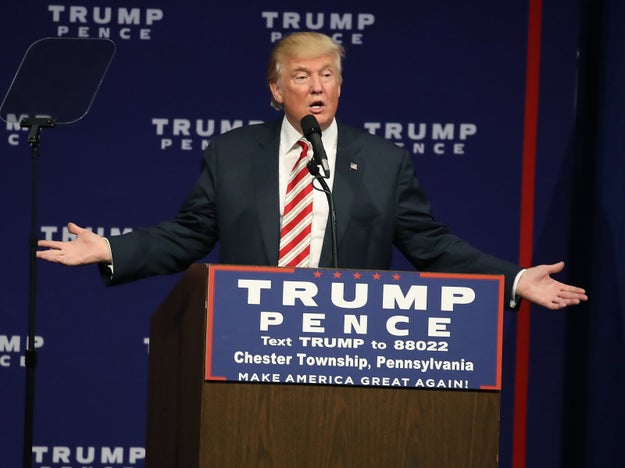
Republican presidential nominee Donald Trump speaks during a campaign rally September 22, 2016 in Aston, Pennsylvania.

Mark Wilson / Getty Images

The Trump Hotel Collection has agreed to pay thousands of dollars in penalties for not properly disclosing a series of hacks on its computer network, dating back to 2014, that resulted in the theft of 70,000 of its customers’ credit card numbers and other personal data.

New York Attorney General Eric T. Schneiderman announced the settlement with the Trump Hotel Collection on Friday. The hotel chain, whose locations from Las Vegas to New York were affected by the data breach, will have to shell out $50,000. As part of the settlement, the chain also committed to improving its data security practices.

In May 2015, according to the Attorney General’s press release, multiple banks found that thousands of fraudulent credit card transactions traced back to several hotels under the management of Trump International. Investigators soon linked the stolen credit card information to a cyber attack on May 19, 2014, when a hacker accessed Trump International Hotels’ payment processing system through an administrative account using legitimate login credentials. The hacker then deployed malware into the system that stole the hotels’ customer credit card information and other data, according to the Attorney General’s office.

Investigators alerted Trump International Hotels of the attack in June 2015, but the company did not notify its customers until September of that year, when it posted a notice of the breach on its website. This delay was the basis of the Attorney General’s recent charges, which found that Trump International violated a New York business law that requires hacked companies to notify consumers “in the most expedient time possible and without unreasonable delay.”

Six Trump hotels in New York City, Miami, Chicago, Honolulu, Las Vegas, and Toronto were affected by the hack.

A spokesperson for Trump Hotels said in a prepared statement, “Unfortunately, cyber criminals seeking consumer data have recently infiltrated the systems of many organizations, including almost every major hotel company. Safeguarding our customers’ data is a top priority for the company and we will continue taking actions to do so.”

The credit card theft was not Trump International Hotels’ only data breach in the past few years, the Attorney General’s office found. In November 2015 — five months after the hotel chain had learned of the first hack — a hacker installed credit card harvesting software in Trump International’s system that yielded information used in more credit card fraud. Fraud investigators found that the hacker later took more personal information, including the social security numbers of about 300 people, from a different company system in March 2016. Trump International received notice of these breaches in late March 2016, but the company waited three months, until June 2016, to tell its customers that their data had been stolen from its system.

Forensic investigators had recommended that Trump International implement two-factor authentication after the first breach, back in 2015. The company waited until April 2016 to do so, and the Attorney General said Trump International could have prevented the subsequent breaches if it had bolstered its security the first time it learned about its system’s security vulnerabilities.

Paul Martini, CEO of iBoss Cybersecurity, said of the breach, “Understanding the severity of [a] breach can be complex … but there&;s no excuse to withhold news of the breach. Some organizations say they&039;re going to gather more info; some raise their hands and say, &039;we don&039;t have the expertise&039; — but any choice should include reporting the breach.”

As for the forensic investigators&039; recommendations, Martini said even those steps might not have been enough to protect the hotel customers&039; data. “Multi-factor authentication would have helped preclude someone logging into the network administrator&039;s account, but it wouldn&039;t have prevented the hijacking after the malware was already in the payments processor,” he told BuzzFeed News.

When BuzzFeed News asked what this data breach means for Trump&039;s cybersecurity record as the Republican nominee, his campaign responded:

“Donald Trump is the only candidate who will ensure American interests are effectively protected, unlike Hillary Clinton who has proven herself to be utterly incompetent as evidenced by her illegal use of an unsecured email server that was completely vulnerable to hacking.”

Quelle: <a href="Trump Hotels Kept Their Customers&039; Credit Card Hack Secret For Months“>BuzzFeed

Announcing the new Docs Repo on GitHub!

By John Mulhausen
The documentation team at Docker is excited to announce that we are consolidating all of our documentation into a single GitHub Pages-based repository on GitHub.
When is this happening?

The new repo is public now at https://github.com/docker/docker.github.io.
During the week of Monday, September 26th, any existing docs PRs need to be migrated over or merged.
We’ll do one last “pull” from the various docs repos on Wednesday, September 28th, at which time the docs/ folders in the various repos will be emptied.
Between the 28th and full cutover, the docs team will be testing the new repo and making sure all is well across every page.
Full cutover (production is drawing from the new repo, new docs work is pointed at the new repo, dissolution of old docs/ folders) is complete on Monday, October 3rd.

The problem with the status quo

Up to now, the docs have been all inside the various project repos, inside folders named “docs/” &; and to see the docs running on your local machine was a pain.
The docs were built around Hugo, which is not natively supported by GitHub, and took minutes to build, and even longer for us to deploy.
Even worse than all that, having the docs siloed by product meant that cross-product documentation was rarely worked on, and things like reusable partials (includes) weren’t being taken advantage of. It was difficult to have visibility into what constituted “docs activity” when pull requests pertained to both code and docs alike.

Why this solution will get us to a much better place

All of the documentation for all of Docker’s projects will now be open source!
It will be easier than ever to contribute to and stage the docs. You can use GitHub Pages’ *.github.io spaces, install Jekyll and run our docs, or just run a Docker command:
git clone https://github.com/docker/docker.github.io.git docs
cd docs
docker run -ti &;rm -v &;$PWD&;:/docs -p 4000:4000 docs/docstage
Doc releases can be done with milestone tags and branches that are super easy to reference, instead of cherry-picked pull requests (PRs) from several repos. If you want to use a particular version of the docs, in perpetuity, it will be easier than ever to retrieve them, and we can offer far more granularity.
Any workflows that require users to use multiple products can be modeled and authored easily, as authors will only have to deal with a single point of reference.
The ability to have “includes” (such as reusable instructions, widgets that enable docs functionality, etc) will be possible for the first time.

What does this mean for open source contributors?
Open source contributors will need to create both a code PR and a docs PR, instead of having all of the work live in one PR. We’re going to work to mitigate any inconvenience:

Continuous integration tests will eventually be able to spot when a code PR is missing docs and provide in-context, useful instructions at the right time that guide contributors on how to spin up a docs PR and link it to the code PR.
We are not going to enforce that a docs PR has to be merged before a code PR is merged, just that a docs PR exists. That means we should be able to merge your code PR just as quickly, if not more so, than in the past.
We will leave README instructions in the repos under their respective docs/ folders that point people to the correct docs repo.
We are adding “edit this page” buttons to every page on the docs so it will be easier than ever to locate what needs to be updated and fix it, right in the browser on GitHub.

We welcome contributors to get their feet wet, start looking at our new repo, and propose changes. We’re making it easier than ever to edit our documentation!
The post Announcing the new Docs Repo on GitHub! appeared first on Docker Blog.
Quelle: https://blog.docker.com/feed/

Cracking The Tinder Code: Love In The Age Of Algorithms

Alraun2014 / Getty Images

I used to be terrible at Tinder — but for a few weeks this summer, I was pretty good. Women responded to my messages. Our chats went deeper than usual. Previously stalled discussions were suddenly revived and I was right-swiped with increasing frequency. I began to understand my matches in a way I hadn’t previously, but not because of anything I&;d done. My Tinder messages were being composed by a woman who also set up my profile. And I was using Tinder’s on staff sociologist’s input to refine my approach.

I handed over my account to my colleague, Jessica Misener, on a hunch (correct) that I wasn’t doing things right on Tinder. And while Jessica didn’t really need the help, I took over her account as well. We embarked on our great switcheroo in an attempt to get to the bottom of what makes Tinder tick; customizing each other’s profiles to what we thought people of our gender wanted, releasing those accounts into the wild, and then comparing the results to our past luck.

We swapped accounts on the condition that no message could be sent without the explicit approval of its real owner — this was a quest to understand the inner workings of the platform, not dupe people. And, when we were done, we brought our findings to Tinder, which reviewed them and — based on its own research including some previously unreleased data — told us what we&039;d done right and wrong. Spoiler: I had a lot to learn. And judging from the Tinder profiles we saw, you probably do too.

Downloaded by more than 100 million people, Tinder is responsible for some 1.5 million in-person dates each week, according to its creators. It’s helped to normalize “meeting online.” Tinder did this with an ingeniously simple swipe “right for like”/”swipe left for dislike” vetting process, connecting people only when there is mutual interest. Its soaring popularity has helped revolutionize modern dating, shifting us from finding love via chance to finding it via algorithm.

Wearing a hat in your Tinder profile pic? That’ll hurt your chances by 12%.

The secrets of Tinder&039;s code lie in the hands of people like Dr. Jess Carbino, a Tinder employee with a sociology PhD. from UCLA. She has a lot of visibility into what works on Tinder and what doesn&039;t. For instance: Wearing glasses in your profile picture, whether for vision or sun, decreases your chances of being right-swiped by 15%. And a hat? That’ll hurt your chances by 12%.

“It&039;s really important for people to able to glean a great deal about your face, which indicates things beyond attractiveness,” Dr. Carbino explained in a phone interview from Tinder’s Los Angeles headquarters last week. Tinder is willing to share a good deal of this data because, at the end of the day, it wants people to find satisfying matches. And, if you use Tinder, you probably want more matches too. So take your damn hat off. And, while you’re at it, those shades need to go too.

In Trusted Hands

Stock_colors / Getty Images

Looking through the men showing up on Jessica’s Tinder account, I saw many dudes presenting themselves with blurry pictures, mirror selfies, hats, nowhere-looking gazes, and other off-the-charts terrible selfies. When I saw a guy with a clear picture, smiling and looking toward the camera, I instantly swiped right.

When Jessica set up my profile, she chose a picture of me looking sideways to start, and then followed with a few looking straight at the camera. A week in, thinking about that man with the straightforward smile, I suggested we switch up my own profile. We chose a photo I didn’t love, but where I looked straight at the camera and smiled. It worked significantly better than my previous profile pic.

“Individuals who are front facing are 20% more likely to be swiped right on.”

The forward-facing smile was the right move, according to Tinder’s Dr. Carbino. “Individuals who are front facing are 20% more likely to be swiped right on, relative to their counterparts who are facing sideways or not showing themselves,” Dr .Carbino said. Even though I felt the smiling picture was worse than any other, it made a big difference: you are 14% more likely to be swiped right on if you smile on Tinder, Dr. Carbino said.

After Jessica landed a few matches on my behalf, I watched in amazement as she crafted thoughtful, personalized messages to each. My opening message is perhaps best described as, “How’s it going?” Jessica describes hers as: “Not just, ‘Oh cool you&039;re from North Carolina? I like Asheville a lot,’ but: “Oh you&039;re from North Carolina? I&039;ve always wondered if the Carolinas have a rivalry about which is better. like South Carolina is OBVIOUSLY cooler but North Carolina is literally on top of it, which seems significant to me.”

Jessica’s method proved effective. Conversations kicked off with thoughtful messages were far richer than my usual “Hey,” “Sup,” “Nm, U?” variety. And Tinder’s data seems to bear this out. Dr. Carbino said Tinder is conducting a messaging analysis study, and its initial results indicate more thoughtful messages are more likely to generate responses. You can also always send a GIF, which is 30% more likely to get a response, according to Dr. Carbino.

Viewing Tinder from my colleague Jessica’s vantage point, I didn’t need any special conversational tactics. If anything, the biggest challenge was weeding people out.

Stampede

Xavier Arnau / Getty Images

Running Jessica’s account felt like watching dozens of men attempting to run through the same tiny door at once. It was overwhelming. As I swiped right, a pattern emerged: Match. Match. Match. Match. Message. Message. Message. Message. These guys meant business. They were relentless.

Watching them in action, I began to rethink one of my core Tinder principals: never double text. Sending a message, waiting, and sending another message despite no response had long been no go territory for me. It felt needy, and a bit delusional. If someone was interested, they’d respond. If not, they wouldn’t. But as I witnessed the volume and pace of messages hitting Jessica’s Tinder, I very quickly saw the folly of my ways.

Double texting works, according to Dr. Carbino, who calls it re-engagement. “The idea of re-engagement, if done in a way that&039;s appropriate, can be quite effective,” she told me. “You can say something along the lines of, “Hey, it&039;s time to step up your Tinder text game&039; and make a joke out of it to re-engage them and to try to further the conversation along in a way that&039;s more meaningful.”

On Tinder, you can also use a ‘Super Like’ button once every 24 hours to signal more interest than the ordinary ‘like,’ but the people using this feature felt a bit off to me, so I started swiping left and rejecting them all out of habit. That wasn’t a normal behavior. Super Likers, according to Tinder, are three times more likely to match, and their conversations typically last 70% longer than those of non-Super Likers.

Super Like or not, you may want to go for the real-world encounter early as possible. People who meet in person via Tinder typically do so within 2-7 days of matching, according to Dr. Carbino.

Tinder God Emerges

Siphotography / Getty Images


“I always said great advertising should be like dating.”

When you first sign up for Tinder, a text overlay appears on the app urging you to “Swipe more to help us learn your preferences. The more you swipe, the better our recommendations&;” The prompt is subtle, and it’s also the most prominent indicator that Tinder sorts the profiles it shows you via an algorithm — a mathematical formula that pulls in a number of data points and makes decisions about who comes next.

The keys to Tinder’s algorithm are held by Dan Gould, a former advertising technology executive who spent the early part of his career attempting to match the right ad to the right person at the right time — now he’s doing it with people. That a former ad-tech exec now holds a power position at a dating company says a lot about the role of algorithms in romance today. “I always said great advertising should be like dating,” Gould told me. “If advertising works perfectly, it would be like finding that great partner for you. It would find the right thing, at the right time, at the right price, and maybe something you didn’t even know.”

According to Gould, Tinder&039;s algorithm gives a lot of weight to the choices you make while setting preferences. Distance ranges, gender and age preferences — all these things need to match up before Tinder will show you a potential match. Two other critical factors are distance and recency. Distance is straightforward: being closer gives you an edge. But “active time,” i.e. recency, is more intriguing. “People who have been active recently are more likely to come back soon and interact with other people.” Gould said. “While I probably shouldn’t say how you can game the system, the one thing that a person can really do to appear to a lot more people and get more matches is to be active recently. If I were trying to get more matches I would open the app every hour and just swipe a little bit.”

Swipe Life

Demaerre / Getty Images

In their book Modern Romance: An Investigation, the comedian Aziz Ansari and NYU sociology professor Eric Klinenberg describe asking a woman to project her OkCupid in-box on a screen in an LA comedy club. “The moment we put her in-box up on the screen, you could see every man in the room just deflate,” Klinenberg said in a recent phone interview. “They suddenly realized what they were up against.”

The draw of that choice is so powerful that Seattle-based Ricky Burnett, founder of a company called Project Attraction, a dating coaching service that promises to help men “become the confident, bad ass guy that women obsess over,” said he sees a lot less competition when trying to meet someone in real life. “I consider it to be a lost art these days,” he explained. “You kind of put people in awe when you just walk up to them and say ‘hi.’”

Proliferation of choice can have negative consequences as well. With so many potential matches to swipe on, they all become a bit more … disposable. “Go back to [the pre-Tinder] era,” said relationship Psychologist Dr. Karen Sherman. “If you didn’t meet somebody in college then what the hell were you going to do? Because then you were pretty much out of possibilities. Now, so what?

For Dr. Carbino, algorithmically-assisted courtship is a clear net positive. “There&039;s so much data out there that suggests that individuals who meet their partners online have more satisfactory relationships and are more likely to get married faster, relative to individuals who meet offline,” she said.

Klinenberg is of a similar opinion. He likes to tell a story of how he and Ansari once asked a “pretty average looking” guy for a look at his dating in-box. The guy, Klinenberg said, had messages from women who “30 years ago, if he had gone to a bar and they had given him their phone number, he would’ve gone crazy, it would’ve been the greatest night of his life.” There&039;s a lesson in that in-box: “There’s a lot of volume. Even if that guy was striking out 95% of the time, it’s a whole lot easier to start flirting with someone and ask them out online, than it is in person.”

After swapping Tinder accounts with Jessica and getting Tinder&039;s input, I made more progress on long-unanswerable question: “What did I do wrong?” than ever before. You can&039;t quantify everything in the age of algorithms, but more and more is becoming knowable. Now if you&039;ll excuse me, I have some swiping to do.

Quelle: <a href="Cracking The Tinder Code: Love In The Age Of Algorithms“>BuzzFeed

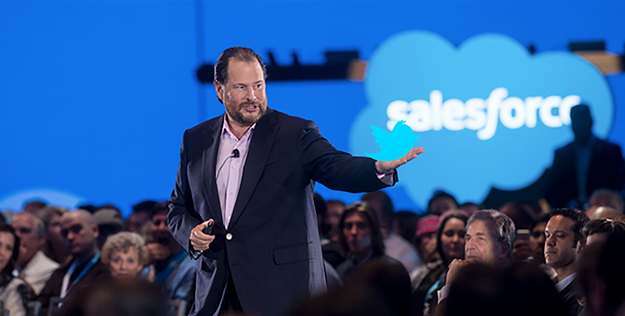
How Twitter Would Fit Inside Salesforce

Salesforce

As Twitter struggles to grow its userbase and meet Wall Street&;s expectations, its been increasingly the subject of rumors that it may have to sell out in order to stay alive. Those rumors really ramped up today following a CNBC report that a number of companies have expressed interest in buying the social platform and formal bids could be in soon from the likes of Google and others.

But one potential named suitor left a lot of people scratching their heads and others even downright sullen: Salesforce. Salesforce is a business-to-business technology company that&039;s prominent within that circle but relatively unknown in the consumer space.

But the two companies could fit well together, for a number of reasons. Consider the following:

The Ad-Tech

This is the big one. Salesforce&039;s core product helps you market and sell to people you know, ad-tech helps you market to people you don&039;t know (yet). Twitter has made two ad-tech acquisitions (MoPub and TellApart) and has hundreds of millions of logged in users, helping it connect user identify across devices. Bringing Twitter&039;s ad-tech capabilities in house could provide Salesforce with a more deeply integrated offering at a time when its entire industry is working on ways to own the “full funnel,” helping clients message from the point someone first becomes aware of their product to the moment when they buy it.

The Intelligence

If Salesforce can parse meaning from Twitter data (Executive A is interested in X,Y and Z), it could help prospecting sales reps be smarter about the way they approach potential customers. Earlier this month, Salesforce introduced “Einstein,” an AI-powered product that Salesforce promises can help its clients by “automatically discovering relevant insights, predicting future behavior, proactively recommending best next actions and even automating tasks.” For AI to work, it needs a lot of data. Twitter has a mountain of data. By purchasing Twitter and all its associated data, Salesforce could get that product revving fast.

The Small Social Fit

Salesforce has tried its hand at social with Chatter, a social platform built into its product, but that part of Salesforce could use some improvement (spoken as a former sales guy who&039;s used it). Having Twitter&039;s staff build up the social aspects of Salesforce could be big for the company. Executed right, it would increase the cohesiveness and communication among teams using the product.

Bret Taylor

Twitter board member Bret Taylor sold his company, Quip, to Salesforce in August for $582 million. As Recode points out, “some people think he’d be a good fit to run Twitter’s core product.” So Salesforce could already have a product head in place.

The Benioff Factor

Salesforce CEO Marc Benioff is a showman and a guy who likes to stir the pot. Benioff has stuck his neck out on enough social issues that he could probably enjoy some goodwill as he works to fix Twitter&039;s harassment issue, one of its biggest problems. Benioff also happens to like social, and thinks it&039;s critical to his customers&039; success. As he told CNBC a few years ago: “As a marketer, as a sales professional, you&039;d better know what&039;s happening on those social networks because those are your customers. We&039;ve seen brands go haywire when one tweet goes wrong.”

Quelle: <a href="How Twitter Would Fit Inside Salesforce“>BuzzFeed

The Amazon EMR-DynamoDB Connector for Apache Hive and Apache Spark is now open-source

Amazon Web Services has open-sourced the emr-dynamodb-connector, which enables Apache Hive and Apache Spark on Amazon EMR to access data in Amazon DynamoDB. You can process data directly in Amazon DynamoDB using these applications, or join tables in Amazon DynamoDB with external tables in Amazon S3, Amazon RDS, or other data stores that can be accessed by Amazon EMR. The connector is still included for use on each node in your Amazon EMR cluster. To learn more or contribute to the project, visit the emr-dynamodb-connector GitHub page.
Quelle: aws.amazon.com